
Newsletter / Reports
Your Value-Creation Plan Has a Translation Problem
By Dr. Reggie Padin, Aimpro + ExpandPro · September 3, 2026
Your Value-Creation Plan Has a Translation Problem
Traditional human capital assessments answer an important question: Do we have the right people?
They surface leadership capability, succession gaps, retention risk, critical role coverage. When that work is done well, sponsors leave with a confident read on the talent in the building.
But that question is not the same as this one: Is the organization those people are leading actually configured to execute the value-creation plan?
The gap between those two questions is where value quietly disappears.
Capable Leadership Is Not the Same as Organizational Alignment
You can have a strong CEO, a credible leadership team, and solid people in the seats that matter—and still have a company where the operating system is working against the plan.
The pricing strategy changed, but sales incentives were never updated.
The growth thesis depends on cross-selling, but each business unit still protects its own revenue.
AI is part of the productivity case, but managers are still measuring—and rewarding—the old workflow.
The VCP calls for faster decisions, but approval authority is still buried three levels deep.
None of those problems is a talent problem. The CEO is not the issue. The leadership team isn't the issue. The issue is that the operating system underneath those leaders contains contradictions that make execution harder than it has to be Expandpro-pe-execution-intelligence-kb-3.S1].
This is the pattern that shows up after a deal closes, after a management review, sometimes after a missed board target—and it almost never appears in an assessment that was designed to evaluate people rather than operating conditions.
What a Contradiction Actually Looks Like
A workforce contradiction isn't a communication failure or a morale problem. It's an observable inconsistency between what one part of the operating system demands and what another part of the operating system rewards, teaches, or permits [Expandpro-pe-execution-intelligence-kb-3.S1].
The AI example is worth dwelling on. Seventy-eight percent of organizations reported using AI in 2024 [BENCHMARK-ai-workforce-trends.S1]. Most sponsors have an AI angle in the value-creation plan. But when technology spending isn't matched by workflow redesign, role-specific capability, and manager reinforcement, the income-statement impact doesn't follow [Expandpro-pe-execution-intelligence-kb-3.S6]. The tool exists. The productivity gain doesn't. That's not a readiness problem—it's a contradiction between the strategy and the daily behavior managers are actually reinforcing.
The same logic applies to commercial transformations. A sponsor prioritizes margin improvement. The CEO communicates it clearly. The CRO acknowledges it. But sales managers are still coaching to monthly revenue, because that's what gets celebrated and what quota still measures [Expandpro-pe-execution-intelligence-kb-3.S4]. All four parties can sincerely say they support the VCP while behaving according to incompatible definitions of success.
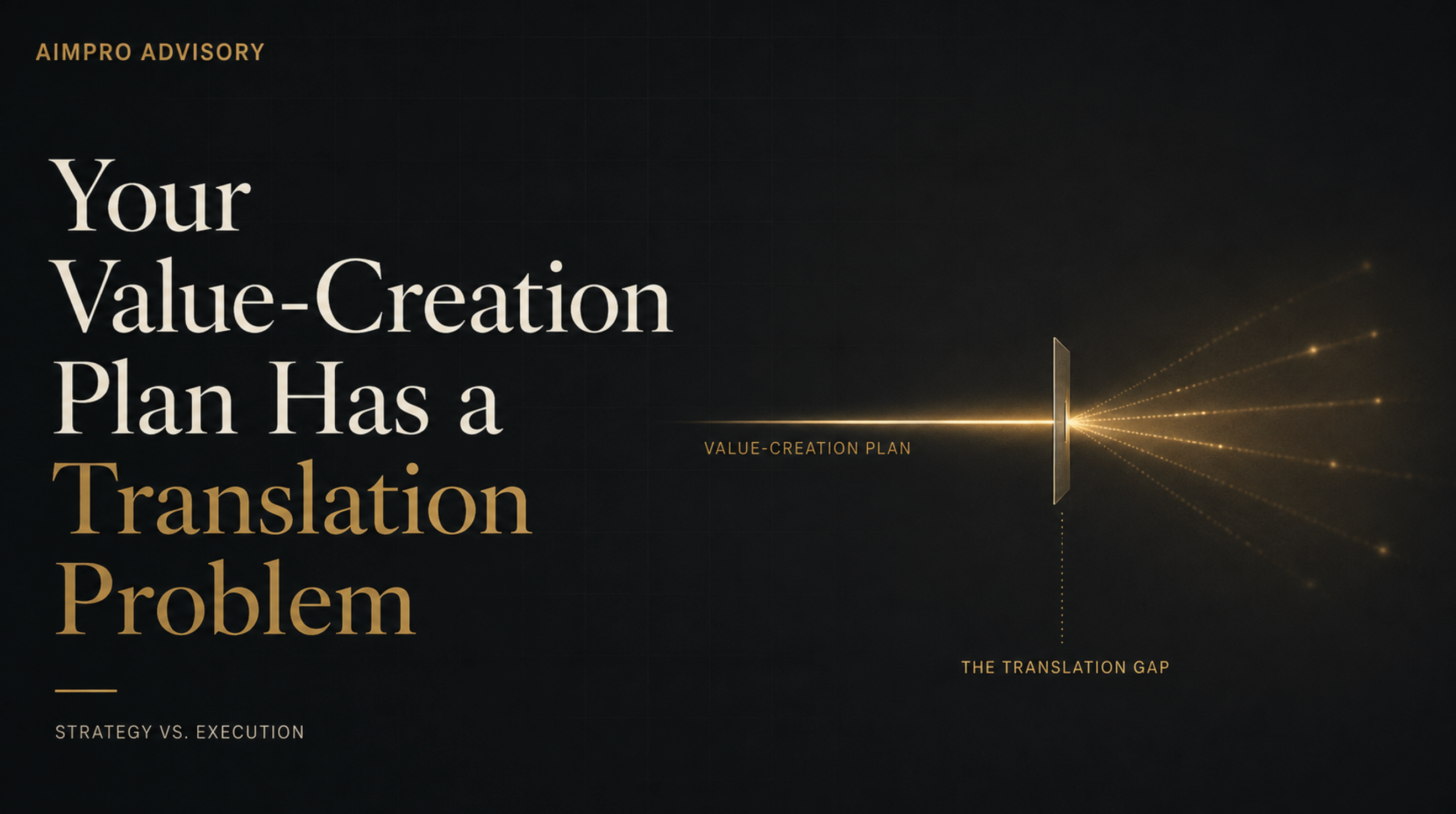
That's the translation problem. The plan is sound. The people are capable. But the operating system hasn't been updated to match what the plan now requires.
Why Standard Assessments Miss This
Traditional assessments are built to evaluate people. That's what they're designed to do, and most do it well.
What they're not designed to evaluate is whether the incentive structure, decision rights, management reinforcement, and operating workflow are coherent with the specific investment thesis currently in play [Expandpro-pe-execution-intelligence-kb-3.S3].
Leadership executability is contextual. A CEO who performed well in a stable organic-growth environment may struggle when the thesis requires a rapid buy-and-build integration. A strong founder may lose traction when the VCP demands standardization and delegation. The question isn't whether a leader is capable in the abstract—it's whether this leader, with this team, can execute this particular plan under these particular conditions [Expandpro-pe-execution-intelligence-kb-3.S3].
That question requires a different kind of evidence. It requires looking at what managers are actually reinforcing—not just what leadership is saying [Expandpro-pe-execution-intelligence-kb-3.S2]. It requires checking whether the measurement and reward system reflects the priority the sponsor believes is in place. It requires triangulating across what the plan says, what the incentive structure rewards, what system data shows, and what the financial results are beginning to signal [Expandpro-pe-execution-intelligence-kb-3.S7].
A single evidence source is rarely enough. Contradictions gain confidence only when multiple independent signals point to the same inconsistency.
The Diagnostic Question That Changes the Conversation
There's a specific question that reframes the whole conversation with management:
Where is your operating system making your own strategy harder to execute?
It's not accusatory. It doesn't start with the assumption that leadership is failing. It starts with the recognition that most VCP execution problems aren't leadership problems—they're system problems. The pricing policy, the incentive design, the approval hierarchy, the workflow that managers inherited, the metrics that still appear in the monthly review—these are the conditions the plan has to move through.
When those conditions contradict the plan, capable people execute less than they should. When those conditions are aligned, the same people execute more than most assessments would predict.
The translation problem isn't about the quality of the document or the quality of the team. It's about whether the operating layer underneath the plan was actually updated to carry the plan.
That's what execution intelligence is designed to find—and it's what a traditional talent assessment, by design, was never built to answer.