
Newsletter / Reports
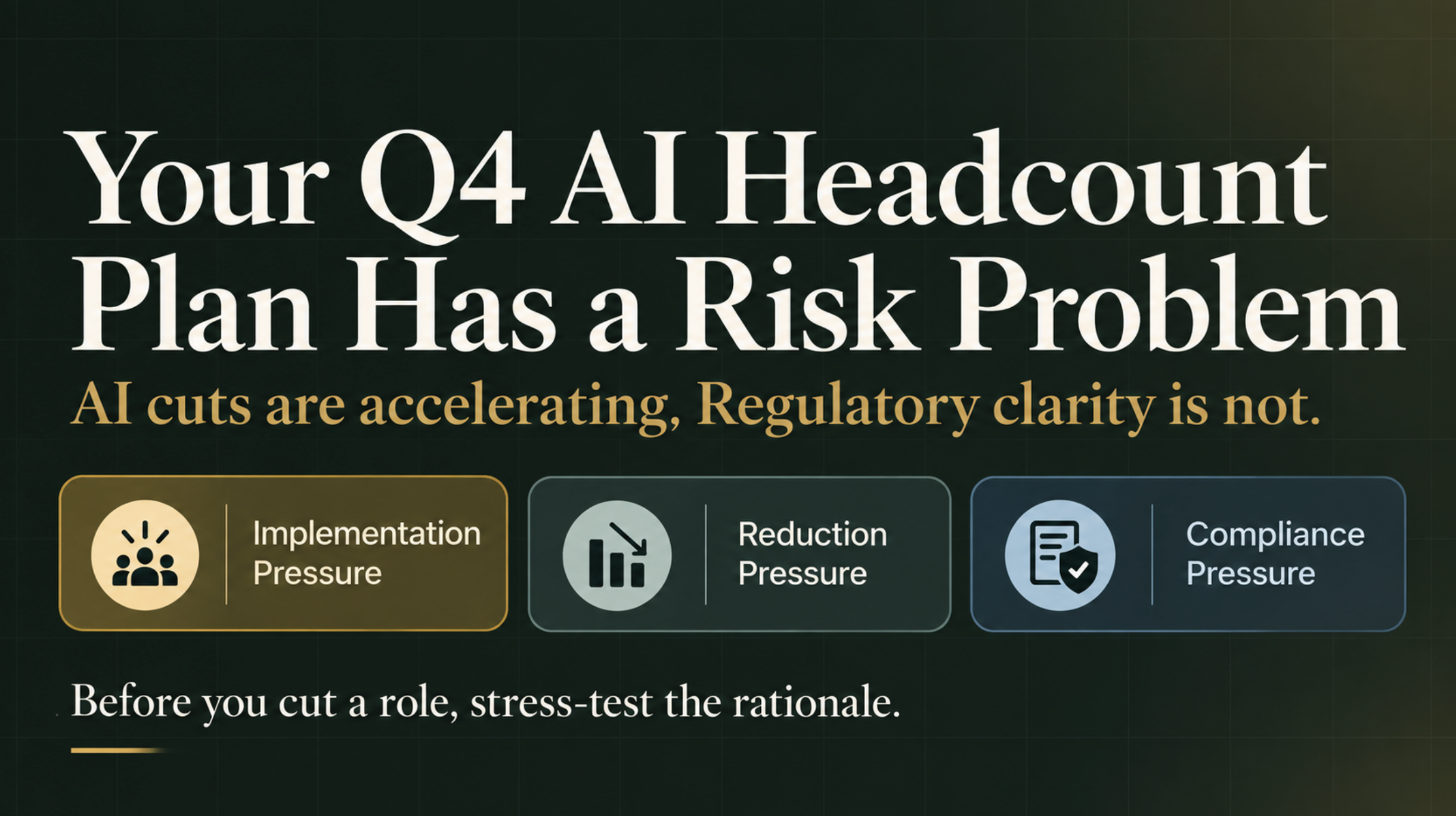
Your Q4 AI Headcount Plan Has a Risk Problem
By Dr. Reggie Padin, Aimpro + ExpandPro · September 10, 2026
Your Q4 AI Headcount Plan Has a Risk Problem
The AI workforce conversation just changed.
For most of 2026, companies have been asking:
Which jobs will AI eliminate?
That is no longer the most important question for mid-market leaders.
The question entering Q4 is:
Can you defend the workforce decisions you're about to make?
Three developments are now colliding.
1. AI workforce planning is moving from prediction to implementation
Gartner's nine-trend framework and McKinsey's work on skill partnership are increasingly pointing organizations toward the same practical challenge:
AI strategy has to become operating design.
That means deciding:
- Which roles disappear.
- Which roles get redesigned.
- Which tasks move to AI.
- Which decisions remain human.
- Which new skills become necessary.
- Who owns AI quality and exceptions.
- How managers measure the redesigned work.
The conversation is shifting from:
"What will AI change?"
to:
"What exactly are we changing Monday morning?"
That is a very different management problem.
2. The reduction pressure is arriving at exactly the wrong time
Reporting from DQ India and SQ Magazine continues to document acceleration in AI-related workforce reductions.
For mid-market companies entering Q4 planning, that creates enormous pressure:
AI investment → productivity target → headcount assumption → budget decision.
But those decisions are being made while the rules around AI and employment are still developing.
Which creates the third problem.
3. Regulation is moving underneath the workforce plan
The UC Berkeley Labor Center has been mapping an increasingly fragmented landscape of AI-related workplace legislation, proposals, and protections.
That matters because a reduction decision made in September 2026 may be evaluated later under a legal and regulatory environment that looks different from the one management sees today.
The risk isn't simply:
"Could we eliminate this position?"
The stronger question is:
"Could we explain, document, and defend why we eliminated it?"
Those are not the same thing.
The Mid-Market AI Workforce Stress Test
Before approving an AI-related role reduction, leadership should be able to answer five questions:
1. What work is actually disappearing? Not the title. The work.
2. What work is transferring to AI? Identify the task, workflow, and expected productivity gain.
3. What work still requires human ownership? Think judgment, exceptions, quality, customers, escalation, and accountability.
4. What evidence supports the headcount decision? "AI should make us more productive" is not evidence.
5. Would the rationale still look defensible if regulatory scrutiny increased next year?
That last question is becoming increasingly important.
REDESIGN vs. REDUCE
This may be the most useful distinction consultants can bring into Q4 planning.
REDESIGN
The job remains, but AI changes how the work gets done.
The intervention becomes:
Workflow + skills + management + measurement.
REDUCE
The organization concludes that materially fewer people are required.
The intervention becomes:
Evidence + documentation + governance + compliance.
And there is a dangerous third category:
UNDECIDED
Leadership has already put the savings into the 2027 plan...
…but hasn't actually determined whether the role should be redesigned or eliminated.
That is where I would look first.
The window is narrowing
Many companies deferred the hardest AI workforce decisions through the summer.
Now Q4 planning is forcing those decisions back onto the table at the same time that:
AI capability is improving. Layoff pressure is increasing. Workforce redesign is getting more complicated. The regulatory environment is still developing.
For mid-market leaders, this creates a deceptively simple rule:
Do not make an AI headcount decision faster than you can build the evidence behind it.
Because the AI business case may be right...
…and the workforce decision can still be wrong.
That contradiction could become one of the most expensive AI implementation mistakes of 2027.
#AI #MidMarket #WorkforceStrategy #AITransformation #FutureOfWork #TalentStrategy #HumanCapital #Leadership