
Newsletter / Reports
Why Most Corporate Universities Become Content Warehouses
By Dr. Reggie Padin, Aimpro + ExpandPro · October 5, 2026
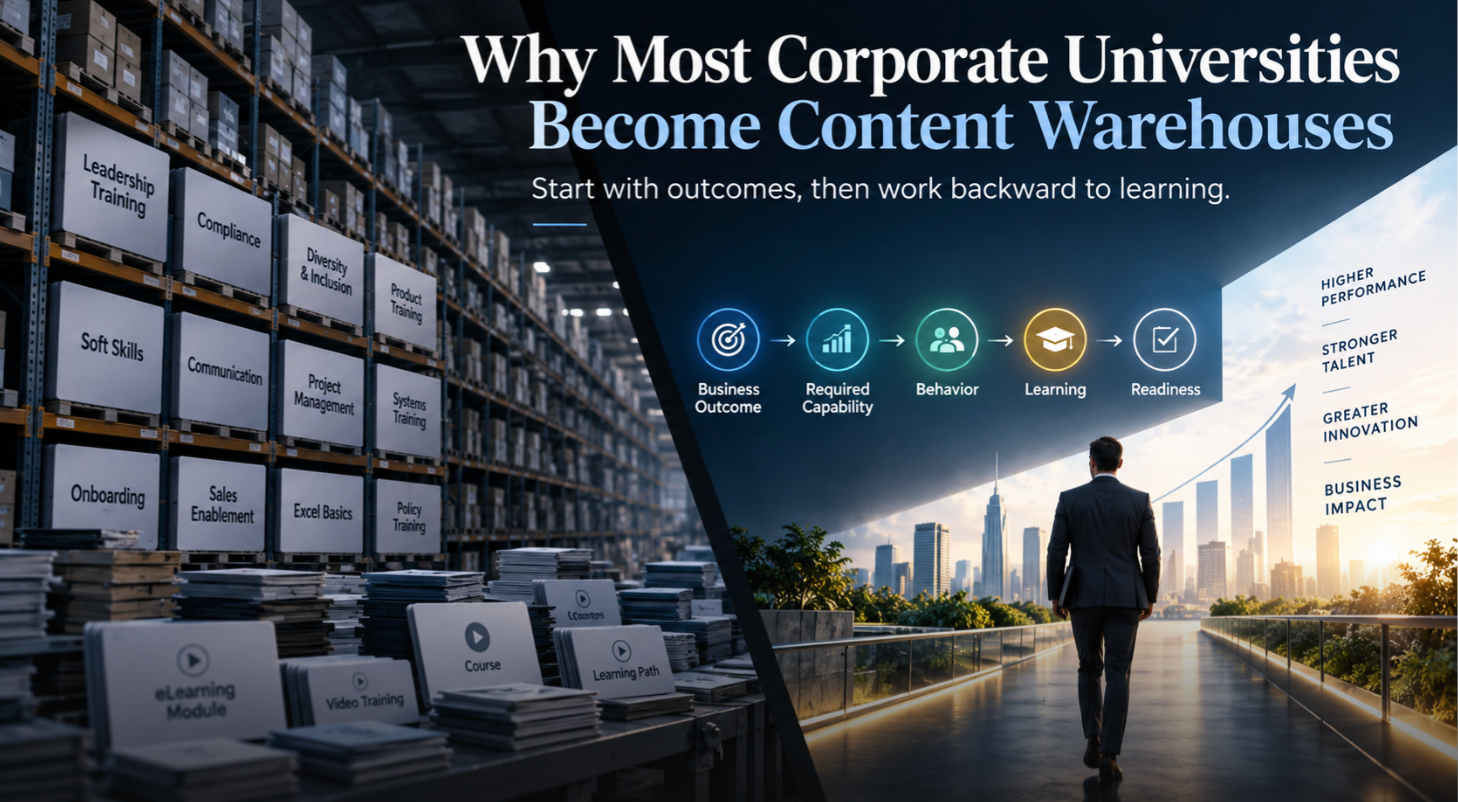
They begin with a question about content—"what courses should we build?"—and end up with a library nobody uses and a business nobody changed. The alternative is to begin with a question about outcomes, and to work backward through a chain that connects learning to results.
Every corporate university starts with good intentions. A mandate, a budget, a leader, a team. A promise that this time, learning will be different—strategic, aligned, connected to the business.
Six months in, the conversation has shifted. It's about curriculum. Course catalogs. Content libraries. Vendor relationships. Completion dashboards. The platform is live. The courses are published. The activity metrics look healthy.
Two years in, the corporate university is a content warehouse. It stores and distributes learning the way a warehouse stores and distributes inventory. It has a lot of it. It knows what's inside. It can track what moves. But nobody can say with confidence whether any of it made the business better.
This isn't a failure of effort. It's a failure of sequence. The corporate university asked the wrong first question—and everything downstream followed from it.
The Wrong First Question
The question that most corporate universities begin with is:
What courses should we create?
It's an understandable question. Courses are what a learning function produces. They're visible, tangible, and countable. They feel like progress. The question is also comfortable—it doesn't require arguing with the business, negotiating with executives, or proving anything beyond delivery.
But it's the wrong question, for a simple reason: it starts from the supply side. It assumes the answer is content, and works forward to figure out where to put it. The result is a catalog built around what's easy to teach rather than what the business needs to change.
A content warehouse doesn't fail because the content is bad. It fails because the content was never connected to an outcome. It's inventory without demand. Supply without a business case. Learning activity without learning impact.
The Right First Question
The question that produces a corporate university—rather than a content warehouse—is a different one:
What business capability must improve?
This question changes everything that follows. It starts from the outcome, not the content. It forces the conversation upstream, into the business, where the actual requirements live. It makes the corporate university accountable for something other than activity. And it produces a chain—not a catalog—that connects learning to results.
That chain is the operating logic of a real corporate university. It runs like this:
Business Outcome → Required Capability → Behavior → Learning → Readiness → Reinforcement → Measurement
Read it left to right, and you have a design methodology. Read it right to left, and you have a diagnostic. Either direction, it's the difference between a corporate university and a content warehouse.
Let's walk the chain.
The Chain, Step by Step
1. Business Outcome Start here, always. What outcome is the business trying to achieve? Improve margin. Reduce errors. Enter a market. Increase retention. Accelerate ramp. Improve customer satisfaction. The outcome is the reason the corporate university exists—and it must be stated in the language of the business, not the language of learning.
The test: Can you name the specific business outcome this initiative is meant to move, and does a business leader agree it matters?
2. Required Capability Given that outcome, what capability must improve? Not "what do people need to know" in the abstract—what must the workforce be able to do for the outcome to happen? Capability is the bridge between the outcome and everything downstream. If the outcome is "reduce errors by 30%," the required capability might be "operators can identify and escalate edge-case failures correctly."
The test: Is the required capability specific, observable, and directly connected to the outcome?
3. Behavior Capability shows up as behavior. What must people do differently—in their daily work—for the capability to be real? Behavior is the concrete, observable expression of capability. It's what a manager can see, reinforce, and coach.
The test: Can a manager describe what this behavior looks like when it's happening—and when it isn't?
4. Learning Only now do we get to learning—and it's shaped by everything upstream. What learning will produce that behavior? It might be a course. It might be a structured experience, a coaching program, a simulation, a job aid, or a knowledge resource. Learning is the intervention, chosen to fit the behavior—not the other way around.
The test: Is this learning designed backward from the behavior, or assembled from what's available?
5. Readiness Learning isn't complete until the person can perform independently, to standard. Readiness is the validated state—demonstrated, observable, and assessed. This is where the corporate university becomes accountable for capability rather than exposure. (See our piece on what "ready" actually means.)
The test: Is readiness defined and validated—or assumed because the learning was completed?
6. Reinforcement Learning decays without reinforcement. The manager is part of the learning system—whether you designed it that way or not. (See our companion piece.) Reinforcement is where behavior becomes embedded, and it's the step most corporate universities never design.
The test: Is there a deliberate mechanism for reinforcing the behavior in daily work—or does it depend on the manager's instincts?
7. Measurement Finally, measurement closes the loop back to the outcome. Not completion rates. Not satisfaction scores. Business outcomes and the capability metrics that lead to them: ramp time, error rates, quality, productivity, retention, internal mobility, customer experience, operating performance. (See our piece on completion being the least interesting number.)
The test: Can you trace a line from this initiative to a business metric—and report against it?
Why the Chain Matters
The chain isn't a framework for its own sake. It's a discipline that prevents the drift toward a content warehouse. Here's what it changes:
It makes the business the starting point. You can't design learning without a business outcome, because that's where the chain begins. This forces the corporate university into a conversation with the business—and keeps it there.
It makes capability the unit of design. Not courses, not topics, not hours. Capability. This is a different unit of analysis, and it produces a different kind of institution.
It makes behavior the target. Learning isn't the goal. Behavior is. This distinction is what separates development that changes performance from development that produces certificates.
It makes readiness the standard. Not completion. Not attendance. Demonstrated ability. This is the quality gate that content warehouses don't have.
It makes reinforcement structural. Not optional, not dependent on hero managers—designed in. This is the step that determines whether learning survives contact with the real work.
It makes measurement the closing loop. The chain ends where it began: with the business outcome. If the outcome didn't move, the chain tells you where it broke—and that's actionable.
What Breaks Without the Chain
When the chain is missing, the failure modes are predictable—and familiar:
No business outcome → learning with no purpose. Courses exist because someone wanted them, not because the business needed them. The catalog grows; the impact doesn't.
No required capability → training without a target. Learning is designed around topics rather than capabilities. People complete it without being able to do anything differently.
No behavior → knowledge without application. The learning happens, the certificate is issued, and nothing changes on the job.
No readiness → exposure mistaken for competence. Completion is treated as evidence of capability, and the gap surfaces later as errors, slow ramp, or quality problems.
No reinforcement → decay. The training fades within weeks because nothing in the environment supports the new behavior.
No measurement → activity mistaken for impact. The corporate university reports completions and satisfaction, and can't say whether anything improved—which means it can't defend its budget when pressure comes.
Every one of these failure modes produces the same result: a content warehouse. Lots of inventory, no demand signal, no traceable impact.
The Content Warehouse Test
If you're not sure whether your corporate university is a content warehouse in disguise, run these five questions:
- Can you name the business outcomes your learning programs are designed to move? If not, you're building content.
- For your flagship program, what required capability does it develop—and who confirmed that? If the answer comes from the learning team, not the business, you're guessing.
- How do you know the learning produced the behavior? If you can't describe the behavior or point to evidence of it, you're tracking exposure.
- What reinforces the behavior after the learning ends? If the answer is "managers," but managers weren't designed in, the reinforcement doesn't exist.
- What business metric moved because of this program? If the answer is completion, you've found the warehouse.
Any "no" in that list is a place where the chain is broken—and a place where the corporate university drifts back toward being a warehouse.
What a Real Corporate University Looks Like
The alternative isn't aspirational. It's operational. A corporate university that follows the chain looks like this:
- It starts every initiative with a business outcome, confirmed by a business leader.
- It designs from capability, not from content. The catalog serves the capability model, not the other way around.
- It targets behavior, and it can describe what the behavior looks like when it happens.
- It chooses learning deliberately—course, experience, coaching, simulation, job aid—whatever produces the behavior best.
- It validates readiness through demonstration, not completion.
- It designs reinforcement into the manager's role, with tools, time, and expectations.
- It measures business outcomes and reports against them, quarter over quarter.
This is what a corporate university is for. Not to store content, but to produce capability. Not to deliver learning, but to change the business.
The Bottom Line
Most corporate universities become content warehouses because they start with the wrong question. "What courses should we create?" produces a catalog. "What business capability must improve?" produces a system.
That system is a chain: Business Outcome → Required Capability → Behavior → Learning → Readiness → Reinforcement → Measurement. Every link depends on the one before it. Break any link and the chain fails—and the corporate university drifts back toward being a library with a login.
For CEOs and COOs, this is the difference between learning as activity and learning as execution. For CFOs, it's the difference between spend with a measurable return and spend that can only report activity. For CHROs, it's the operating logic that turns a corporate university from a cost center into capability infrastructure—and the discipline that keeps it from becoming a warehouse.
The question worth asking:
When our corporate university plans its next initiative, does it start with a course to build—or a business capability to improve?
If it starts with the course, you have a warehouse. If it starts with the capability—and works the chain—you have the beginning of something that actually changes the business.
Start with the outcome. Build the chain. Then the catalog takes care of itself.