
Newsletter / Reports
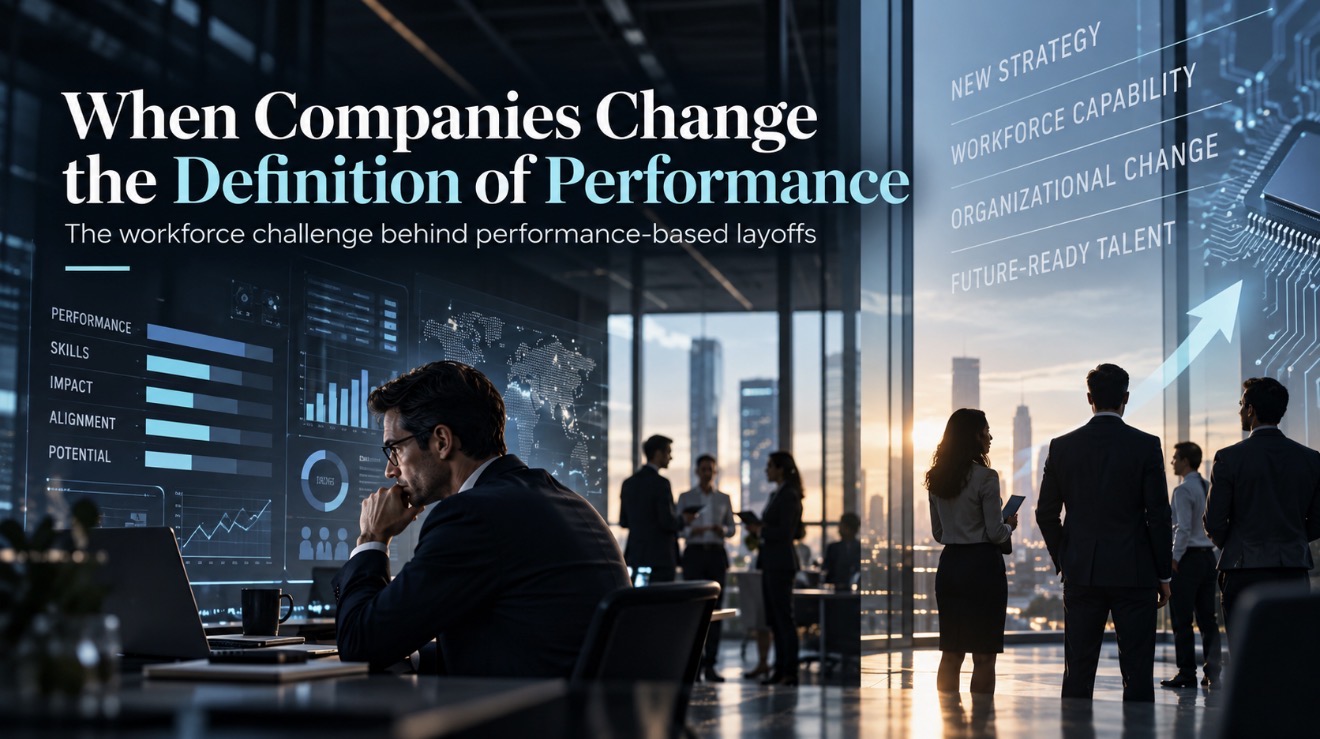
When Companies Change the Definition of Performance
By Dr. Reggie Padin, Aimpro + ExpandPro · October 21, 2026
On October 20, Reuters reported that Qualcomm plans to eliminate jobs worldwide following its annual performance reviews. According to an internal memo from CEO Cristiano Amon, the reductions are intended to strengthen the company’s performance culture, with affected employees expected to receive notifications beginning in November.
But one particular statement caught my attention.
“As we have expanded the business, so have the competencies and skills we require.”
That statement deserves more attention than the layoffs themselves.
Qualcomm is navigating a significant business transformation, expanding beyond its traditional smartphone chip business into areas such as AI data centers. Naturally, that transformation requires different capabilities, new expertise, and potentially different organizational structures.
There is nothing inherently unreasonable about expecting employees to meet changing business requirements. Companies must evolve to remain competitive.
But it raises a question that I believe every CEO, CHRO, and business leader should be asking:
When an organization changes what it needs from its workforce, who is responsible for preparing that workforce to meet those expectations?
And perhaps more importantly, how do we distinguish an employee who is genuinely underperforming from one whose role, expectations, and operating environment have changed without adequate preparation?
When performance becomes a moving target
Consider an employee who has consistently met expectations for five years. They understand their responsibilities, deliver quality work, and contribute to their team’s success.
Then the company introduces a new strategic direction.
AI becomes central to the business. Processes are redesigned. Productivity expectations increase. New technologies become part of everyday workflows, and leadership begins measuring success differently.
Six months later, that same employee receives a disappointing performance review.
What happened?
Perhaps the employee resisted change or failed to develop necessary skills. That is certainly possible.
But perhaps the organization never clearly explained how the role would change, never established appropriate development pathways, or continued reinforcing behaviors that no longer supported its strategic priorities.
Both situations can produce disappointing performance results.
Yet they require entirely different interventions.
One is primarily an individual performance problem. The other is an organizational execution problem.
When companies cannot distinguish between the two, they risk treating symptoms while leaving the underlying conditions untouched.
The organizational contradiction nobody measures
For much of my career working in learning, leadership development, and organizational performance, I’ve observed a recurring disconnect.
Leadership announces a new strategy. Human Resources updates competency frameworks. Learning and Development introduces training programs. Department managers continue operating under existing priorities, while performance reviews measure a mixture of old and new expectations.
Each function may be doing exactly what it was asked to do.
The problem is that they are not necessarily working toward the same outcome.
Imagine a company announcing that AI adoption will be a strategic priority for 2027. Its employees receive access to AI tools and complete several training modules. Leadership reports strong participation and celebrates a successful rollout.
But frontline managers are still rewarding employees based on traditional productivity metrics. Job descriptions remain unchanged. Workflows still require the same approvals, and employees have little opportunity to apply what they learned.
By the end of the year, AI adoption has disappointed leadership.
Was that a training failure? An employee performance failure? Or did the organization create conditions that made successful adoption unlikely?
Training completion is not evidence of workforce readiness. And a performance rating is not necessarily evidence of why performance occurred.
This is the distinction I believe organizations need to become much better at understanding.
Before you evaluate the workforce, evaluate the system
I am not suggesting that performance accountability should disappear or that every employee can be successfully transitioned into every emerging role.
Some strategic changes genuinely require capabilities that cannot be developed within the available time or resources. Organizations sometimes must make difficult workforce decisions.
But those decisions should follow a clear understanding of the organization’s execution environment.
Before attributing performance gaps primarily to employees, leadership should be able to answer several questions.
First, has the strategy been translated into measurable changes in work? Employees cannot execute a transformation that exists primarily in board presentations, executive communications, and annual planning documents.
Second, have roles and competency expectations been updated? If a position requires new skills, those requirements should be explicit, understandable, and reflected in the way work is assigned and evaluated.
Third, has the organization provided meaningful development opportunities? Purchasing technology and assigning online courses are not equivalent to building capability. Employees need appropriate training, practice, feedback, and reinforcement.
Fourth, are managers reinforcing the new expectations? When a company rewards yesterday’s behaviors while demanding tomorrow’s capabilities, employees receive contradictory signals.
Finally, does the performance management process distinguish capability gaps from execution barriers? An employee may understand what needs to change but lack the authority, resources, time, or organizational support necessary to deliver the expected results.
These are not simply HR questions. They are fundamental questions about business execution.
And they are particularly important when performance evaluations influence employment decisions.
Why this matters for mid-market companies preparing for 2027
Qualcomm operates at a scale that most organizations will never approach. But the underlying challenge is especially relevant to companies with 100 to 500 employees.
Mid-market businesses are adopting AI, redesigning operations, consolidating responsibilities, and pursuing ambitious growth or efficiency objectives.
Many are doing so without the dedicated organizational development, workforce analytics, and change management resources available to larger enterprises.
The CEO may have a clear vision of what the company should become. The leadership team may agree with that vision. Yet the employees responsible for executing it may still be operating within systems built for a different business model.
This is where workforce alignment becomes a strategic issue rather than an HR initiative.
A company can have talented employees, competent managers, modern technology, and an excellent strategy and still struggle to execute because those elements contradict one another.
The solution is not automatically more training, better communication, another software platform, or a new performance management process.
It begins with understanding where the contradictions exist.
Are strategic priorities reflected in departmental goals? Do employees possess the capabilities their roles now require? Are managers reinforcing the right behaviors? Are incentives aligned with the organization’s direction? And is there measurable evidence that development investments are improving actual performance?
Without that visibility, leadership risks making consequential workforce decisions based on incomplete information.
The real leadership test of 2027
I do not know whether Qualcomm has provided adequate development opportunities to its employees, whether its performance evaluations accurately reflect individual contributions, or how the company has prepared its workforce for changing business requirements. The Reuters report does not establish those facts.
My concern is broader than Qualcomm.
Across industries, the pace of strategic change is accelerating, especially as organizations pursue AI-enabled productivity and new operating models.
We are entering a period when companies will increasingly expect their existing workforces to deliver capabilities that were not part of their original jobs.
That expectation is not unreasonable.
But it creates a corresponding leadership responsibility.
If organizations want different performance, they must examine whether they have established the conditions necessary to produce it.
Otherwise, performance management can become a mechanism for identifying employees who failed to adapt to an organizational transformation that was never fully implemented.
The question isn’t simply whether employees are meeting expectations. It’s whether the organization has aligned its strategy, structures, capabilities, incentives, and management practices around those expectations.
That is the difference between measuring performance and understanding performance.
And it may become one of the most consequential distinctions leaders make in 2027.
A question for CEOs, CHROs, and business leaders:
When your company’s strategic priorities change, how do you determine whether disappointing performance reflects an employee capability gap or a failure in organizational alignment?
At Aimpro Advisory, we’re developing approaches to identifying these contradictions before they become expensive execution problems.
If you’re preparing your workforce for 2027, I’ve included a link to our brief Workforce Alignment Assessment in the comments.
Because before we hold people accountable for executing a strategy, we should have evidence that the organization is equipped to execute it.