
Newsletter / Reports
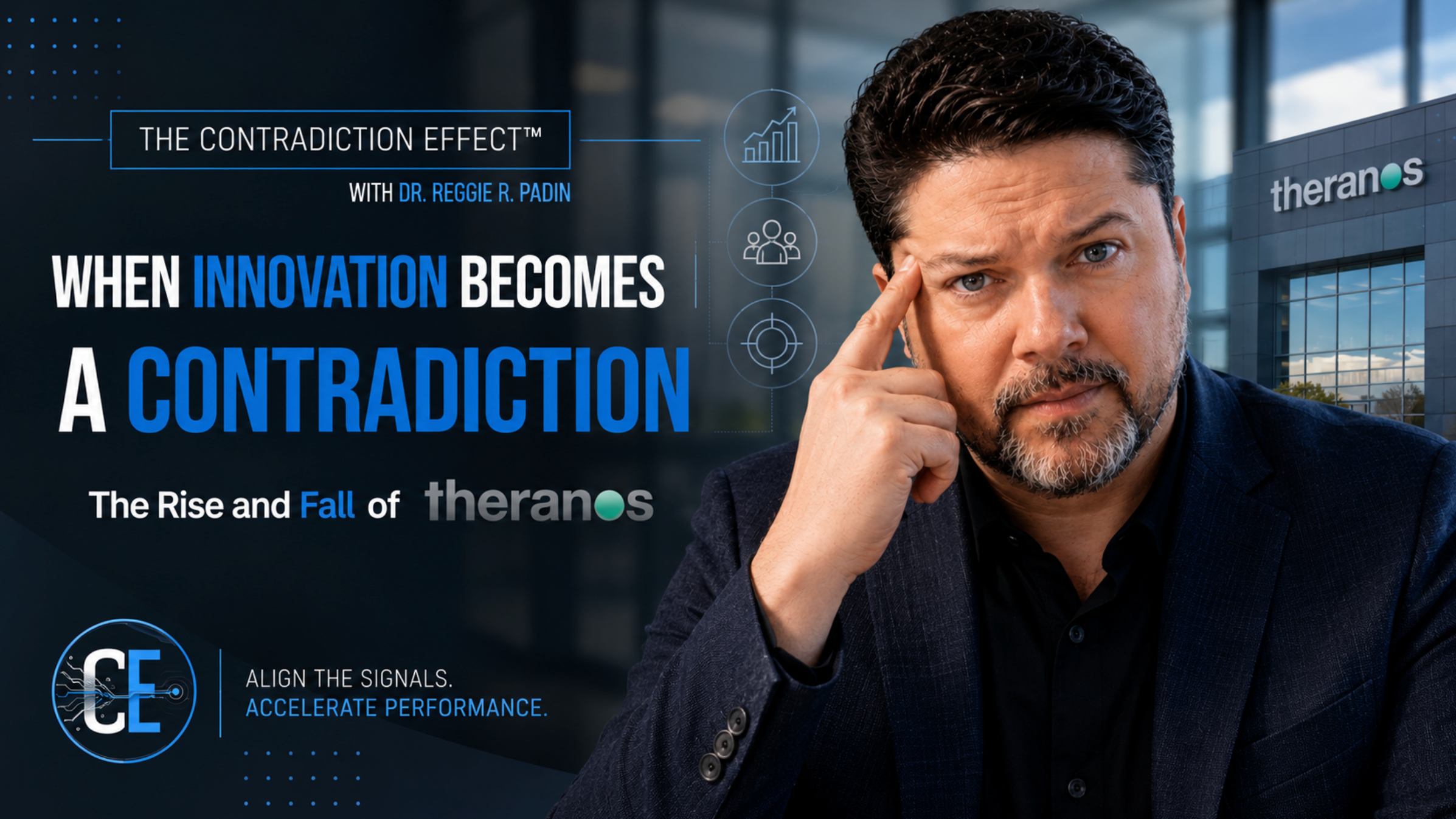
Theranos- When Innovation Becomes a Contradiction
By Dr. Reggie Padin, Aimpro + ExpandPro · July 8, 2026
Elizabeth Holmes raised nearly a billion dollars on a story. One drop of blood. Hundreds of tests. Healthcare democratized. The story was compelling, the mission was real, and the packaging was flawless. The only problem was the product — which never worked the way the story said it did.
Most CEOs reading this aren't running a diagnostics startup. But the mechanism that destroyed Theranos operates at a smaller scale inside workforce systems across mid-market companies every day: the gap between what an organization signals it delivers and what employees actually experience. Presented well enough, for long enough, that gap stays invisible. Until it surfaces in first-year turnover, failed transformation initiatives, and L&D budgets that produced no measurable behavior change.
That mechanism has a name in the methodology I use with clients. It's called a Promise↔Training contradiction.
The Theranos Problem Is a Signaling Problem
Theranos didn't fail because Holmes was bad at storytelling. She was exceptional at it. The company failed because the signals it sent to investors, regulators, and patients — this technology works at the level we've described — were systematically inconsistent with what the technology actually did.
In organizational terms, the same failure pattern plays out when an organization's outward signals — job posts, recruiter conversations, onboarding promises, all-hands announcements — diverge materially from what employees actually encounter once they're inside. The organization is saying one thing. The system is delivering another. Employees resolve the conflict the only way they can: they revise their expectations downward, disengage, or leave.
This is what the Contradiction Index measures — the degree to which an organization's internal systems send conflicting signals to the people working within them [Contradiction-index-methodology-2026.S1]. The Promise↔Training dimension specifically captures the gap between what the organization signals during hiring and what new hires experience in onboarding and their first year [Contradiction-index-methodology-2026.S2].
What This Looks Like in Practice
Here's the pattern I see consistently in mid-market organizations:
The job post describes an innovative, high-growth culture. Onboarding is 80 percent compliance training and process documentation. The recruiter mentions rapid career advancement. First-year promotion rates are below 5 percent. Leadership announces a strategic transformation priority. Six months later, it appears in no one's goals and the budget allocation hasn't moved.
Each of those gaps is a measurable inconsistency between two organizational signals. The rational response to one signal is different from the rational response to the other. Employees figure that out quickly — and they act on it.
The compounding problem: organizations don't usually measure this gap directly. They measure turnover after it happens. They measure training completion, not behavior change. They track engagement scores without connecting them to the specific system contradictions driving disengagement. So the gap stays invisible at the executive level until the cost becomes undeniable — which, by then, is expensive.
For a 200-person organization, contradiction-driven costs typically run $500,000 to $2,000,000 annually, and most executive teams can't see where the money is going [CUSTOM-contradiction-index-methodology-2026.S1].
Why the Labor Market Makes This More Expensive Now
Theranos benefited from a period when scrutiny was low and the story was enough. That window closes. In workforce terms, the equivalent window is closing too — but for different reasons.
The quits rate is running at 1.9 (FRED, May 2026). That's not a peak-churn environment, but it's not zero. Workers still have options, and they exercise them when the gap between what was promised and what was delivered becomes too wide to rationalize. At $32.38 average hourly earnings (FRED, Jun 2026), replacement cost for a mid-market role runs to multiples of annual salary by the time recruiting, onboarding, and time-to-productivity losses are accounted for.
Meanwhile, 78% of organizations reported using AI in some form in 2024, up from 55% the prior year [BENCHMARK-ai-workforce-trends.S1]. Most of those organizations are now making promises to their workforces about what AI adoption will mean — new capabilities, career development, augmented roles. Consultants I'm working alongside in the field are watching those promises land in organizations where manager reinforcement infrastructure doesn't exist, training doesn't match the stated vision, and reward systems still measure the behaviors from two years ago. That's not a technology problem. It's a contradiction problem.
When organizations make large claims about transformation — AI or otherwise — and the system can't deliver on those claims, the Promise↔Training gap widens faster than it can be managed [Contradiction-index-methodology-2026.S4].
The Practical Question for CEOs
Holmes's failure was spectacular and visible. The organizational version of the same failure is slow, diffuse, and invisible until it isn't.
The diagnostic question for any CEO is not whether the organization is performing. It's whether the signals the organization sends — through its hiring process, its onboarding, its stated strategic priorities, its training investments, its performance and reward systems — are coherent with each other. Because performance that depends on individual heroic effort inside an incoherent system is not a sustainable operating model. It's a countdown [CUSTOM-contradiction-index-methodology-2026.S2].
Organizational contradiction doesn't announce itself. It accumulates. The training budget runs and behavior doesn't change [Contradiction-index-methodology-2026.S3]. The strategic priority gets announced and never appears in anyone's goals. The values statement says one thing and the promotion pattern says another [Contradiction-index-methodology-2026.S7]. None of these individually look like a crisis. Together, they set the ceiling on what the organization can actually achieve.
Theranos had an extraordinary story and an incoherent system. The story bought time. The system determined the outcome.
Your workforce is drawing the same conclusion about your organization right now — based not on what you announce, but on whether what you say and what you deliver match. That gap is measurable. And once it's visible, it's fixable.
Take the complimentary AI Readiness Assessment →
Dr. Reggie Padin is the founder of the AILCN and ExpandPro, a workforce alignment intelligence platform. He works with mid-market organizations to identify and eliminate the contradictions slowing AI adoption, execution, and performance.