
Newsletter / Reports
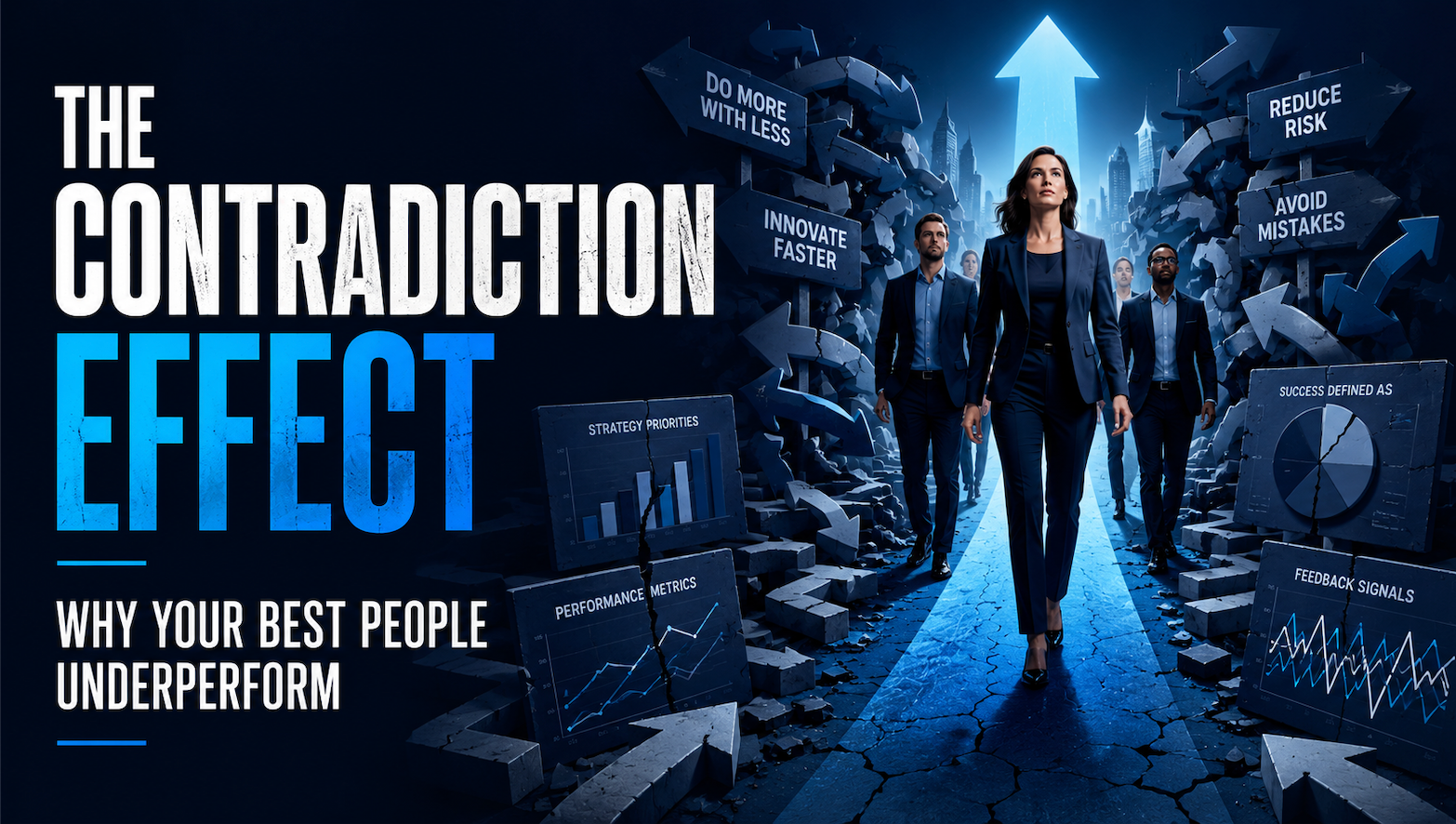
“The Contradiction Effect: Why Your Best People Underperform”
By Dr. Reggie Padin, Aimpro + ExpandPro · June 15, 2026
Your top performer just missed another deadline. Your most experienced manager can't seem to get their team aligned. Your highest-rated employees are producing work that somehow doesn't move the business forward. The problem isn't talent. It's the invisible contradiction built into how your organization operates.
Most mid-market executives assume performance gaps are people problems — wrong hires, insufficient training, motivation issues. But in our work with organizations of 100-500 employees, we consistently find something else: skilled, motivated workers trapped in systems that send conflicting signals about what success actually looks like.
What Creates the Contradiction Effect
The Contradiction Effect occurs when your organization's formal systems — what you measure, what you reward, what you teach, what you promise — work against each other. [Contradiction-index-methodology-2026.S2] Your workforce spends cognitive energy resolving these conflicts instead of executing on your priorities.
Consider this pattern we see repeatedly: A company promotes "innovation" as a core value, trains employees in creative problem-solving, then rewards only quarterly revenue hits. The contradiction is structural. Following the innovation training would mean experimenting, which involves short-term risk. Following the reward system means optimizing for quarterly results, which means avoiding risk. Your best people recognize this contradiction and make a choice — usually the one that protects their career.
The result? [Contradiction-index-methodology-2026.S1] Even talented teams underperform because they're operating within incoherent systems that neutralize individual capability.
The Five Contradiction Patterns That Destroy Performance
Strategy vs. Execution happens when your stated priorities don't appear in actual goals, budgets, or hiring decisions. Your strategic deck declares AI adoption as critical, but no department has AI-related objectives in their OKRs.
Promise vs. Training occurs when new hire experiences contradict what was promised during recruitment. Job posts emphasize "fast-paced innovation," but onboarding is 80% compliance training and process documentation.
Measurement vs. Reward emerges when performance reviews track different behaviors than compensation actually rewards. You measure collaboration but bonus individual contributors. You review quality metrics but pay for velocity.
Teaching vs. Reinforcement develops when training programs teach behaviors that managers don't subsequently coach. [Contradiction-index-methodology-2026.S3] Sales training emphasizes consultative selling, but managers coach pipeline velocity and pitch speed.
Policy vs. Practice appears when written values contradict lived culture. [Contradiction-index-methodology-2026.S7] The handbook promotes work-life balance while the culture rewards constant availability and weekend responsiveness.
The Hidden Cost of Contradiction
Here's what makes this expensive: [Contradiction-index-methodology-2026.S1] Your workforce spends time resolving contradictory signals instead of producing output. A 200-person organization where employees spend just two hours per week navigating system contradictions loses roughly 20,000 person-hours annually — about $1.6 million in pure waste at current labor costs.
But the indirect costs are larger. [Contradiction-index-methodology-2026.S4] Different contradiction patterns degrade different capabilities predictably. Teaching vs. Reinforcement contradictions damage training effectiveness and manager capability. Measurement vs. Reward contradictions kill collaboration and behavioral change initiatives.
Most damaging: your best people recognize contradictions first and leave fastest. They understand what high-performance environments look like and can identify when systems prevent rather than enable performance.
Making Contradictions Visible
The solution starts with measurement. You can't manage what you can't see, and organizational contradictions are usually invisible to the executives paying for them. [Contradiction-index-methodology-2026.S5] Meaningful improvement typically shows as a 15-25 point reduction in contradiction measurement over 9-12 months following targeted intervention.
The diagnostic work involves collecting evidence across eight categories: strategic documents, job descriptions, training catalogs, performance review templates, compensation structures, policy documents, manager interview transcripts, and employee pulse data. The pattern analysis reveals where your systems send conflicting signals and quantifies the specific cost of each contradiction.
Most mid-market organizations discover they have 5-9 distinct contradictions, each contributing to their total performance ceiling. The highest-impact interventions typically focus on aligning what you measure with what you reward, and ensuring that what you teach gets reinforced by managers daily.
Building Coherent Systems
Organizations that eliminate contradictions don't become perfect. They become coherent. Strategy connects to execution. Promises match training. Measurements align with rewards. Teaching gets reinforced. Policy reflects practice.
In coherent systems, individual talent compounds. Investment in any subsystem — training, hiring, performance management, compensation — produces returns because other subsystems amplify rather than neutralize the effect. Your best people stop spending energy resolving system conflicts and start directing that energy toward business outcomes.
The work isn't about perfection. It's about alignment. When your systems point in the same direction, your workforce follows. When they point in different directions, even your strongest performers get stuck choosing between them.
Your talent isn't the problem. The contradiction between your systems is.