
Newsletter / Reports
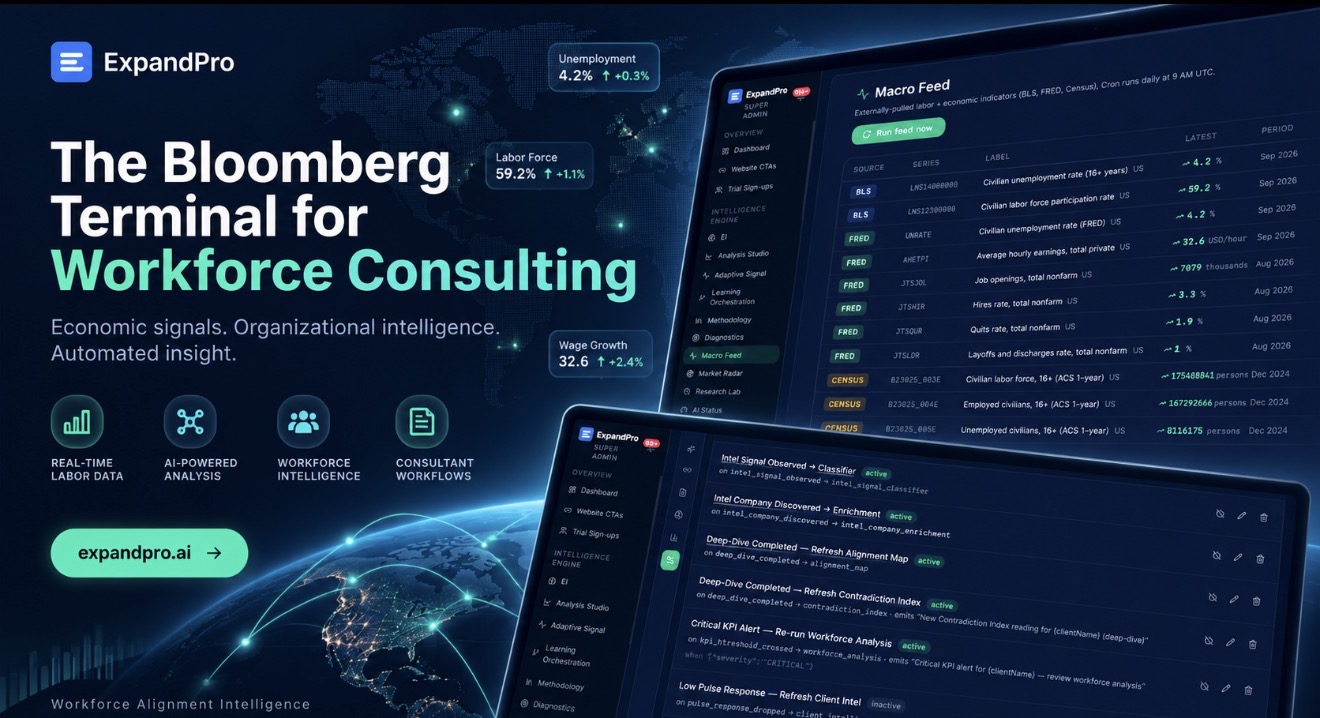
The Bloomberg Terminal for Workforce Consulting
By Dr. Reggie Padin, Aimpro + ExpandPro · October 26, 2026
Financial professionals have always operated with better information than the people making equally consequential decisions about the workforce.
A portfolio manager pulling up a terminal gets live market data, economic indicators, earnings signals, and comparative analytics — all organized around a single question: what should I do next, and what does the evidence say? A workforce consultant advising a CEO on an AI transformation, a CHRO on a restructuring, or a private equity operating partner on whether management can actually execute the value creation plan often walks in carrying disconnected surveys, last quarter's engagement report, and a PowerPoint built from generalizations.
That asymmetry is the problem ExpandPro is designed to close.
What the Gap Actually Costs
Workforce decisions are not soft decisions. They carry the same financial weight as the capital allocation decisions that get the sophisticated analytical treatment.
When a PE-backed company runs an AI transformation and the initiative stalls — not because the technology failed, but because no one redesigned the workflows, built the manager reinforcement layer, or confirmed that the workforce had role-specific capability — that is an execution failure with a direct EBITDA consequence [Expandpro-pe-execution-intelligence-kb-3.S6]. When a sponsor and a portfolio CEO claim alignment on a margin initiative but are operating under completely different definitions of what that means in practice, the divergence shows up in the numbers months later [Expandpro-pe-execution-intelligence-kb-3.S4]. When a company rolls out a new sales methodology and the frontline managers keep coaching the old behavior, the training investment disappears into the gap between what was taught and what gets reinforced every day [Expandpro-pe-execution-intelligence-kb-3.S2].
None of these failures are mysteries after the fact. They are predictable organizational contradictions — observable inconsistencies between what the operating system says and what it actually does [Expandpro-pe-execution-intelligence-kb-3.S1]. The problem is that most firms do not have an infrastructure for detecting them before the financial miss makes them undeniable.
The current labor market makes this more expensive, not less. With 7.1 million job openings and a quits rate still running at 1.9%, organizations competing for capable people cannot afford long onboarding cycles, stalled rollouts, or training programs that fail to change behavior. Every week of execution drift has a replacement cost attached to it.
What Bloomberg Got Right (That Workforce Consulting Hasn't)
The Bloomberg Terminal works because it does not ask you to wait for the annual report. It aggregates signals — some leading, some lagging — into a picture that helps professionals make better decisions faster.
The workforce consulting industry is structurally inverted from that model. The dominant products are backward-looking: engagement surveys that measure how people felt last quarter, exit interview data that arrives after the person has already left, performance reviews that happen annually and are then filed away. The tools are disconnected. The evidence lives in separate systems that no one has organized around an actual decision.
What a genuine workforce intelligence infrastructure requires is different:
First, a decision-anchored frame. The Bloomberg Terminal is built around what a financial professional needs to decide, not around what data happens to be available. Workforce intelligence should be built the same way — starting from the investment thesis, the strategic priority, or the operating initiative, and working backward to what organizational evidence matters for that specific decision. That is what ExpandPro's diagnostic architecture is designed to do: begin with what the company is trying to execute, identify the organizational conditions that have to be true for execution to work, then surface the contradictions between what those conditions require and what the operating system is actually producing [Expandpro-pe-execution-intelligence-kb-3.S5].
Second, triangulated evidence rather than single-source opinion. A strong market read does not come from one signal. It comes from convergence across multiple independent data streams. The same principle applies to organizational diagnosis. A contradiction becomes a material finding when it shows up in what the sponsor intends, what management says, what managers reinforce, what employees experience, what systems record, and what the financial results confirm [Expandpro-pe-execution-intelligence-kb-3.S7]. Any one of those alone is a hypothesis. Multiple pointing in the same direction is evidence worth acting on.
Third, the ability to monitor drift, not just take snapshots. Markets move. Organizations drift. A static assessment tells you where things were on the day of the assessment. The more valuable capability — the one the terminal metaphor makes obvious — is the ability to track whether alignment is improving, holding, or deteriorating, and at what speed. That is the logic behind ExpandPro's Drift Velocity construct: not just a score, but a directional signal that tells you whether the execution risk is compounding.
Why This Matters Now More Than Ever
The editorial signal in the workforce field right now is not subtle. AI adoption is accelerating — 78% of organizations reported using AI in 2024, up from 55% the year before [BENCHMARK-ai-workforce-trends.S1] — but the infrastructure for capturing the value of that adoption is not keeping pace. Macro productivity grew just 0.3% in Q1 2026 [BENCHMARK-ai-workforce-trends.S7]. Organizations are spending on AI faster than they are redesigning work, building manager judgment, or establishing governance. That gap is precisely the kind of contradiction that surfaces early in a well-built organizational intelligence system and late — too late — in a disconnected survey stack.
The convergence of early-career role elimination and an absent reskilling infrastructure that practitioners are tracking right now points to the same structural problem at the workforce level: decisions are being made with consequences that are already visible in the data, but the analytical tools to surface those consequences before they compound are not widely available. The firms that will manage this transition well are the ones that can see the organizational conditions producing their outcomes — not just the outcomes themselves.
The Infrastructure Question
ExpandPro is not another HR dashboard. It is an attempt to build what the workforce consulting industry has been missing: an execution intelligence layer that starts from the question a sponsor, CEO, or operating leader actually needs to answer — can this organization execute what it is being asked to execute? — and works backward to the evidence that makes that question answerable before the miss appears in the numbers.
The Bloomberg Terminal did not replace the judgment of the people using it. It made that judgment better by making the evidence visible, organized, and connected to the decision at hand.
That is the infrastructure workforce consulting needs. That is what we are building.