
Newsletter / Reports
The AI Workforce Crisis Isn't a Technology Problem. It's a Contradiction Problem.
By Dr. Reggie Padin, Aimpro + ExpandPro · November 1, 2026
Redesigning work won't deliver results until leaders deal with the conflicting signals their own organizations send.
Companies are pouring billions into AI. They're automating processes, rolling out agents, and telling employees to work differently. But many of them are also cutting the support their people need to make any of it work.
A recent Human Resources Director article, "Workforce Design Is the AI-Era Gap That Most Organisations Are Missing," makes a similar point. Drawing on research from PwC, JLL, and The Conference Board, it argues that organizations have bought technology without rethinking how work gets designed, distributed, and managed. I agree with that. I just think the problem goes deeper.
Organizations aren't only failing to redesign work. They're trying to transform it through systems that work against the transformation. In my view, those contradictions are among the biggest reasons AI investments don't pay off.
What the numbers show
PwC's 2026 Global Workforce Hopes and Fears Survey covered nearly 50,000 workers in 48 countries and regions. About 64% said they used AI at work in the past year, and daily generative AI use rose from 14% to 22%. Over the same period, the share of workers with access to learning and development resources fell from 59% to 51%.
The leaders running these programs don't feel ready either. The Conference Board found that only 4% of U.S. CHROs feel very prepared to manage AI-driven workforce change over the next two years.
So companies are handing people more powerful tools while taking away the training that would help them use those tools well. Leadership wants transformation, but the budget doesn't always follow. Employees are told to be adaptable and innovative, then sent back to structures built for a different era.
Most people call this an AI readiness problem. I'd call it an alignment problem.
How contradictions undermine AI transformation
The Contradiction Effect looks at how organizations hurt their own performance by sending conflicting signals through strategy, processes, incentives, learning systems, and management practices. This usually isn't about bad leaders, stubborn employees, or weak technology. It happens when different parts of the organization tell people to behave in incompatible ways.
Picture a company that announces a bold AI strategy. Executives talk up experimentation and automation and the need to build new skills. Meanwhile, managers still judge people on how much work they push through established processes. Training is optional, workloads leave no room to experiment, and bonuses reward hitting the same productivity numbers as last year.
The company says it wants innovation, but it pays for continuity. Employees are asked to adopt a new way of working while still being graded by the old rules, and most will follow whichever expectation carries the bigger consequence. That's often a rational response to how the organization is built, not resistance to change. It's also why handing out AI tools, or even redesigning individual jobs, can accomplish so little.
Five contradictions to look for
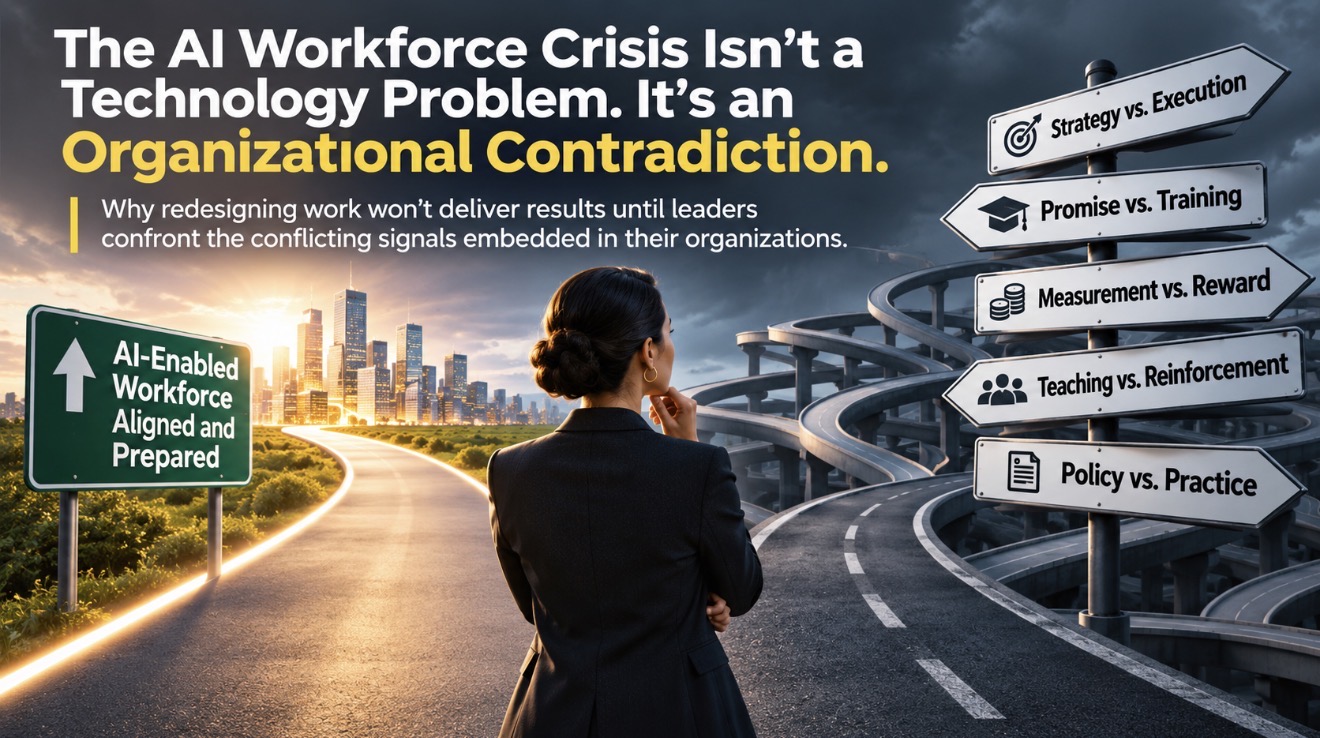
The Workforce Contradiction Index (WCI) measures five kinds of inconsistency. All five show up when companies try to bring in AI.
Strategy vs. Execution. AI-enabled productivity is named a priority, but budgets, approval processes, and reporting lines make experimentation hard. The strategy lives in the announcement and never reaches daily operations.
Promise vs. Training. Employees are promised chances to build AI skills and prepare for new roles. What they get is patchy onboarding, generic courses, and little real preparation for the work they're now expected to do.
Measurement vs. Reward. Performance management is where this is easiest to see. A company celebrates innovation in public but promotes managers for cutting costs, avoiding risk, and hitting current production targets. People learn quickly that what leadership measures isn't always what the organization rewards.
Teaching vs. Reinforcement. The company runs AI literacy workshops and buys a learning platform. Then employees go back to managers who don't have the knowledge, time, or authority to reinforce any of it, and the training never connects to actual performance.
Policy vs. Practice. The AI governance framework, the responsible-use policy, and the commitment to human oversight are all written down. But day-to-day decisions favor speed and output, so the policy says one thing and the work teaches another.
Any one of these can drag down performance. Together, they can stop a well-designed transformation from delivering. And they aren't just employee perceptions or cultural gripes. Leaders can investigate them through decisions that were actually made, expectations that were actually documented, operational data, and how managers actually behave.
Redesign is necessary, but alignment makes it work
The growing focus on workforce design is a real improvement. Leaders have started asking which tasks to automate, which ones need human judgment, and how to organize work around what people and technology each do best, instead of just asking who gets the tools.
But redesigning a role doesn't redesign the environment around it. Take a financial services firm adding AI-assisted analysis. It automates much of the research, documentation, and reporting, and expects employees to spend the freed-up time interpreting results, advising clients, and using professional judgment. If performance metrics still reward transaction volume, managers still prioritize throughput over quality of analysis, and development programs never build consultative skills, the firm has built a contradiction. Its technology supports one operating model and its management system supports another.
The same thing happens in healthcare, manufacturing, professional services, retail, and nearly every other industry bringing in AI. The redesigned job isn't necessarily wrong. The system around it just hasn't changed enough to support it. You can't build an AI-enabled workforce while managing it on pre-AI assumptions.
Why measuring contradiction pays off
Contradictions are hard to spot on a standard dashboard. Leaders track adoption rates, technology spend, training completions, productivity, and engagement, and each of those tells them something useful. None of them shows whether the organization is giving employees conflicting instructions.
An AI course can hit a 95% completion rate and change almost nothing about how people work. A redesigned workflow can make a process technically faster while creating a new approval bottleneck. A new performance system can add innovation metrics while promotions keep going to people who play it safe. Each initiative looks fine on its own, and the organization still misses its goals.
That's why I think contradiction deserves a place in management thinking. Instead of judging initiatives one at a time, leaders should look at how strategic priorities, workforce preparation, performance expectations, manager reinforcement, and real operating practices fit together. The WCI was built on that idea: find where the organization's systems send competing signals, then work out which ones are causing execution problems.
It shifts the question from "Are employees embracing change?" to "Have we created the conditions that let them carry it out?"
What to do before 2027
As companies finalize their 2027 workforce and technology plans, I'd suggest changing the order of the work. Don't start with technology selection, adoption targets, or restructuring. Start with one critical business process. Look at how it runs today, where AI could improve it, and which human skills will matter more as automation grows.
Then look at the conditions around the redesigned work. Are people being prepared for their new responsibilities? Do managers have the skills and the authority to support the shift? Do performance measures recognize the behaviors you want? Do incentives match the strategy? Do your policies and your everyday practices back up the new model?
Wherever the answers conflict, you've found friction. Rank those conflicts by their operational impact and fix them alongside the technology rollout, not afterward as a change-management footnote.
Redesign and adoption should inform each other through hands-on experimentation. But if you scale a new operating model without examining the systems around it, you'll bake the same contradictions in and spread them faster.
This also can't sit with HR or IT alone. Finance, operations, business-unit leaders, and frontline managers all shape the incentives, resources, decisions, and daily expectations that determine whether a transformation works.
The goal isn't a workforce that knows how to use AI. It's an organization that can turn that knowledge into sustained performance.
The real AI advantage in 2027
The next competitive divide probably won't separate companies that use AI from those that don't. It will separate companies that fit AI into a coherent operating system from those that keep layering better technology on top of contradictory structures. The first group gets a shot at higher productivity, stronger people, and a more adaptable organization. The second spends heavily on transformation while keeping the conditions that block it.
AI is getting easier to adopt. Alignment is still hard, and as the technology keeps advancing, the cost of unresolved contradictions will get harder to ignore.
So the question for 2027 isn't how fast you can implement AI. It's whether your strategy, workforce skills, incentives, management practices, and policies are pulling in the same direction. Technology speeds up execution, and in an organization that contradicts itself, it will speed up the contradictions too.
Discover your Workforce Contradiction Score
Before your next major investment in AI, workforce development, or organizational change, check how well your existing systems line up. The Workforce Contradiction Index is a starting point for finding conflicting signals and the sources of workforce drag. Measure the contradiction before you invest further in the transformation.
Dr. Reggie Padin is the author of The Contradiction Effect: How Mixed Signals Create Missed Targets, Hidden Waste, and Workforce Drag.
Sources:
- PwC, Global Workforce Hopes and Fears Survey 2026, September 29, 2026.
- The Conference Board, CHRO Confidence Index, Q3 2026, October 1, 2026.
- Jeffrey R. Smith, "Workforce Design Is the AI-Era Gap That Most Organisations Are Missing," Human Resources Director, October 31, 2026.