
Newsletter / Reports
The $500,000 Training Problem Nobody Calls Training
By Dr. Reggie Padin, Aimpro + ExpandPro · October 1, 2026
The $500,000 Training Problem Nobody Calls Training
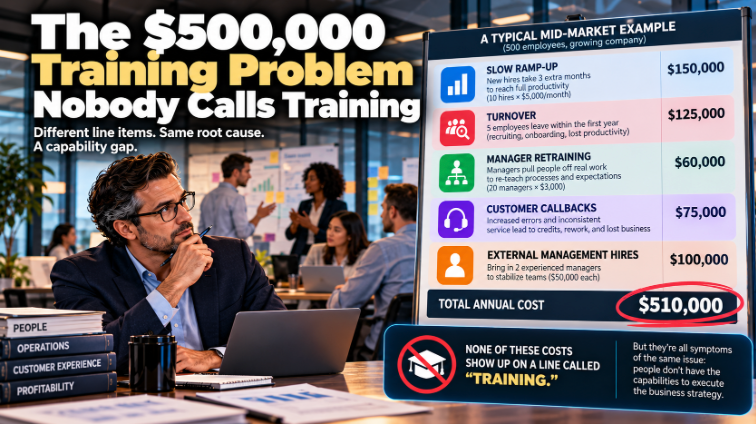
It's not in the L&D budget, and it's not on the training line. It's buried in payroll, turnover, manager time, rework, and outside hiring, and together it comes to about half a million dollars a year. This is what it looks like when a mid-market company finds its biggest training problem was never labeled as training.
Take a company I'll call Meridian. It isn't a real business. It's a composite of dozens I've seen, and I've kept its numbers on the conservative side.
Meridian is a mid-market services company with 500 employees and $90 million in revenue. It's growing modestly and is reasonably well run. There's an HR department, a two-person L&D team, and a $250,000 annual training budget. Leadership thinks the company is good at managing people. Not world-class, but solid.
It also has a $500,000 training problem, and nobody there would describe it that way.
No line item tracks it, nobody owns it, and it never shows up in anything the executive team reviews. The cost is spread across payroll, turnover, manager time, service delivery, and recruiting, and each piece gets its own explanation. "That's salary." "That's the labor market." "That's part of managing people." "That's the cost of delivering the service." "That's recruiting."
Add those pieces together and you get a different picture.
The Inputs
Meridian hires about 80 people a year into roles averaging $65,000 in fully loaded compensation, or roughly $250 per working day. A new hire takes about 90 days to reach full competency and averages around 45% productivity along the way. About 20% leave within their first 90 days, which works out to 16 early departures a year.
The company has 45 people managers. Because the internal leadership pipeline is thin, it fills about six management roles externally each year.
None of these numbers looks alarming on its own. Together they add up to something leadership has never measured.
Cost Category 1: Slow Ramp-Up
New hires take too long to become productive on their own.
At 80 hires a year, 90 days of ramp, and 45% productivity, the gap comes to nearly $1 million annually. That's a big number, so let me pull it back. Say the real ramp is closer to 80 days and average productivity during it is 55%. The productivity gap is then about $720,000 a year.
Not all of that is fixable. Nobody expects full output on day one. So assume only 40% of the gap can realistically be closed through better onboarding, easier access to knowledge, clearer role expectations, structured practice, manager follow-through, and faster skill development. That leaves roughly $288,000 a year tied to capability gaps the company could actually address.
Meridian doesn't see this as a training problem. It sees salary expense. The money sits inside departmental payrolls, and almost no one looks at it as a question of workforce capability.
Cost Category 2: Early Turnover
Twenty percent of new hires leaving inside 90 days means 16 people a year.
Each one costs the company in several ways: recruiting a replacement, losing the onboarding and ramp investment already made, pulling manager time, disrupting the team, paying overtime, and absorbing a temporary drop in output. Meridian puts the total at about $19,000 per early departure, which comes to roughly $304,000 a year across 16 people.
Again, let's be conservative. Suppose a third of those people would have left no matter how good the onboarding, development, management, or role clarity was. That still leaves about $200,000 a year that traces back to capability gaps.
Meridian files this under turnover, and leadership usually puts it down to market conditions. The turnover rate may sit on an HR dashboard, but what weak onboarding and underdeveloped skills cost the business almost never gets calculated.
Cost Category 3: Manager Retraining
This may be the least visible cost of the five.
Meridian's managers spend a good part of each week re-explaining things, answering the same questions, fixing avoidable mistakes, clarifying processes, and making up for knowledge their people should already have. When asked, they put this at three to five hours a week.
Take the low end. Forty-five managers spending three hours a week on preventable retraining, at a loaded value of $55 an hour over 48 working weeks, comes to about $356,400 in manager capacity.
Not all of that is waste. Some questions are new, some situations call for judgment, and good managers should be coaching their teams. So assume a third of those hours are genuinely necessary. The rest, about $237,000 a year, is capability-related.
Where does Meridian record it? Nowhere. Manager time is salaried, so it disappears into "how managers spend their time." There's no invoice, no purchase order, and no budget variance, but the cost is real.
Cost Category 4: Callbacks and Rework
Meridian also has preventable service errors. People misread procedures, standards get applied unevenly, knowledge is hard to find, and different employees solve the same problem in different ways.
What shows up is callbacks, repeat work, service recovery, credits, complaints, and remediation. Meridian spends about $180,000 a year on these.
Suppose only 40% of that can fairly be tied to inconsistent training, unclear standards, poor access to knowledge, or capability gaps. That's about $72,000 a year in addressable cost.
Meridian calls this cost of service. It's baked into operations and margin, which makes the link to capability very hard to see.
Cost Category 5: External Management Hiring
Meridian fills about six management positions from outside every year.
Hiring externally isn't a problem in itself, and sometimes a company should bring in outside talent. The issue is that Meridian often goes outside because nobody inside is ready for the job. That carries a premium: search fees, higher salaries for outside candidates, a longer learning curve, and a greater risk that the hire doesn't stay or doesn't work out.
Meridian estimates the combined premium at about $41,000 per position, which comes to roughly $246,000 a year across six hires. Assume only half of that premium comes from the lack of an internal pipeline, and you still have about $123,000 a year tied to capability gaps.
Meridian calls this recruiting. It rarely asks the better question: why weren't more of our own people ready?
Now Add It Up
Here's the running total:
- Slow ramp-up: about $288,000
- Early turnover: about $200,000
- Manager retraining: about $237,000
- Callbacks and rework: about $72,000
- External management hiring: about $123,000
That comes to roughly $920,000 a year, and it shouldn't be treated as precise. Some categories overlap, some of the inputs are estimates, and some capability costs are hard to separate cleanly. So I'll apply another heavy haircut of about 45% to cover overlap, uncertainty, and measurement error.
What's left is a conservative estimate of about $500,000 a year. On $90 million in revenue, that's roughly 0.6% of the top line going to the consequences of capability gaps, and none of it appears in the training budget.
What Meridian Calls It Instead
Slow ramp-up is classified as salary expense. Early turnover is blamed on market conditions. Manager retraining is absorbed into normal management work. Callbacks and rework are cost of service. External management hiring is recruiting.
That's five costs, five explanations, and five different owners, but possibly one underlying problem: people aren't becoming capable fast enough, consistently enough, or deeply enough to do the work the organization needs.
Meridian's official training budget is $250,000. Its estimated capability problem is $500,000. The $250,000 is visible. It gets budgeted, reviewed, questioned, and sometimes cut. The $500,000 is spread across the business and treated as unavoidable.
The cost of developing people shows up in the training budget. The cost of failing to develop them shows up everywhere else.
What Changes When You Name It
The point of this exercise isn't a perfectly precise number. It's a change in how leadership sees the problem. Once five unrelated operating expenses become one capability problem, the conversation changes in several ways.
The conversation shifts from cost to investment.
A $250,000 learning budget can look like discretionary spending. A $500,000 capability gap looks like operational leakage. If better onboarding, manager enablement, knowledge systems, internal mobility, and structured development can recover even part of that leakage, workforce development stops being about spending money and starts being about recovering money the company is already losing.
Ownership becomes possible.
Costs that are spread out are hard to manage because no single function owns them. HR owns turnover, operations owns rework, finance sees payroll, recruiting owns external hiring, and managers absorb the retraining. Once leadership treats capability as a business system, shared accountability becomes possible. Someone can own ramp time, early retention, manager capacity, preventable rework, and the internal promotion pipeline.
Priorities get clearer.
Meridian doesn't have to fix everything at once. The numbers point to where to look first. Slow ramp-up and manager retraining are the biggest sources of leakage, which suggests starting with onboarding, clearer performance standards, searchable knowledge, manager support, learning built into the workflow, or a redesign of how role readiness is defined.
Instead of asking "What courses should we build?" leadership can ask a better question: "Which capability gap is costing us the most money?"
Progress becomes measurable.
Once the costs are visible, Meridian can set baselines. How long does it take a new hire to reach competency? What share of new hires leave within 90 days? How many hours do managers spend re-teaching basic procedures? How much rework could have been avoided? What percentage of management openings go to internal candidates? These become business metrics, and improvement can be measured against them.
The business case is easier to defend.
Say Meridian spends $150,000 on better onboarding, knowledge access, manager enablement, and role readiness. If that recovers even one-third of the estimated $500,000 in annual leakage, the company gets back about $167,000, and the investment pays for itself in under a year. If the gains continue into later years, the return gets better. That's a conversation a CFO will engage with.
The Generalization
Meridian is fictional. The pattern isn't.
In mid-market companies, the same conditions show up again and again. Ramp time runs longer than leadership thinks. Managers spend more time retraining people than anyone tracks. Early turnover gets blamed on the labor market when onboarding and management may be contributing. Rework gets treated as an operations issue without being traced back to knowledge and skills. External hiring is booked as a recruiting expense instead of being read as a sign of a weak internal pipeline.
Each of these gets managed on its own, and few companies ever add them up. When they do, the totals can be substantial. A conservative estimate of capability leakage can easily land between 0.5% and 2% of revenue, depending on the workforce, the industry, turnover, operational complexity, and how mature the company's development systems are.
Nobody calls it training, but that's often where the problem starts.
The Bottom Line
The $500,000 training problem nobody calls training may be one of the most overlooked expenses in a mid-market company. It doesn't sit neatly inside the L&D budget. It shows up as slower productivity, turnover, manager time, rework, service problems, recruiting costs, external hires, lost organizational knowledge, weak promotion pipelines, and delayed execution.
For CEOs and COOs, the implication is this: you may be spending far more on capability gaps than you are on capability development.
For CFOs: this may be an operating cost that is measurable, manageable, and partly recoverable.
For CHROs and learning leaders: the question changes from "What does training cost?" to "What does it cost us not to build capability?"
That leads to a question worth putting in front of your leadership team: if we added up the cost of slow ramp-up, early turnover, manager retraining, preventable errors, and external management hiring, what would the total be, and why isn't that number on a report?
Meridian found about $500,000. Your organization may find less. It may find a good deal more. Until you calculate it, you won't know.
It's a training problem. It's just not on the training budget.