
Newsletter / Reports
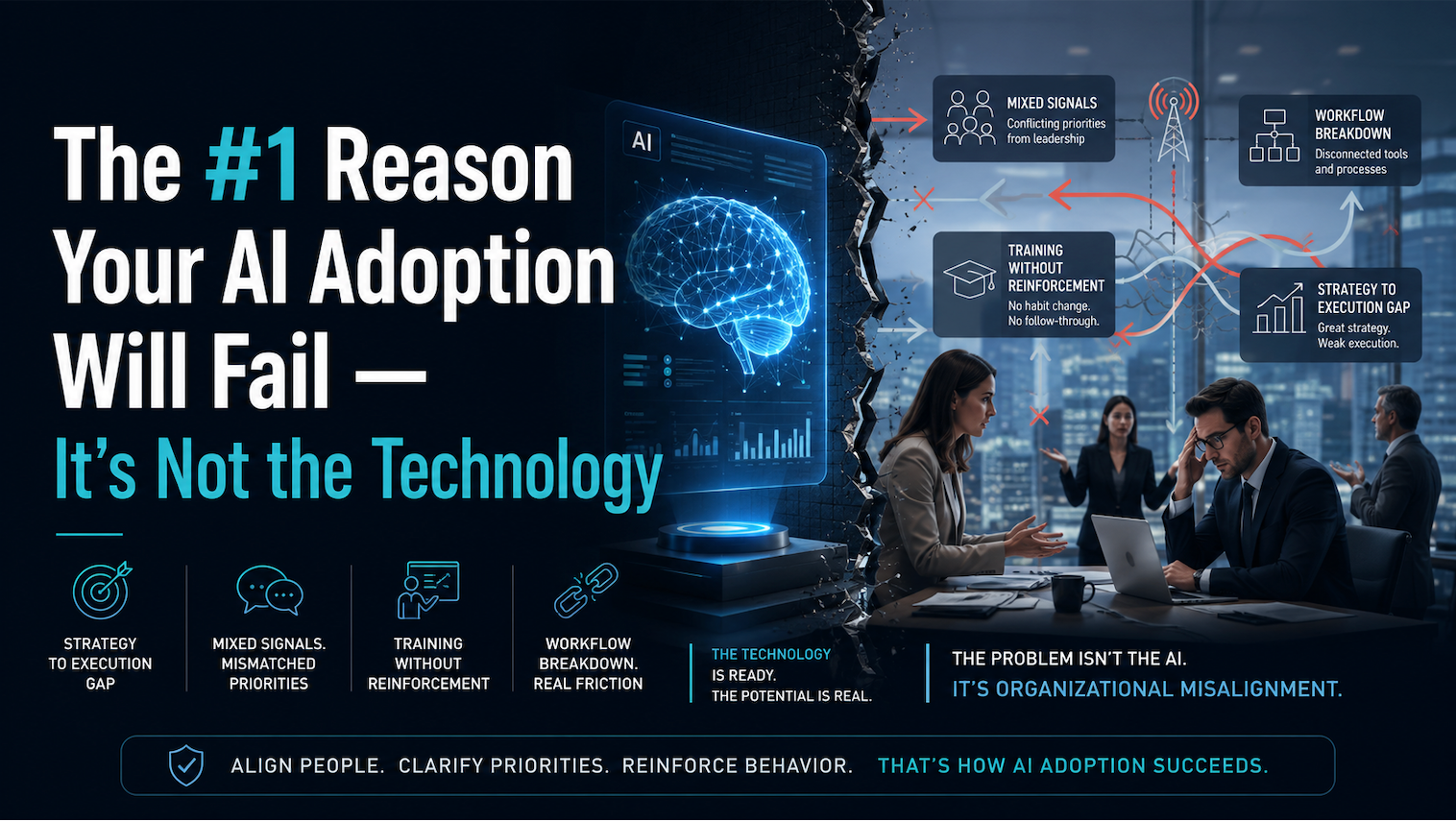
The #1 Reason Your AI Adoption Will Fail — It’s Not the Technology
By Dr. Reggie Padin, Aimpro + ExpandPro · June 14, 2026
Your company has invested heavily in AI tools. ChatGPT subscriptions, workflow automation, smart analytics dashboards. Your training completion rates look good — 87% of employees finished the AI literacy program. Yet six months later, productivity gains remain elusive. Sound familiar?
The problem isn't your technology stack or training design. The problem is organizational contradiction.
While you're teaching employees to use AI tools, your managers are still coaching for pre-AI workflows. Your performance reviews still measure old metrics. Your bonus structure still rewards the behaviors you're trying to change. You've upgraded the tools but left the system intact — and the system always wins.
The Teaching vs. Reinforcement Gap
Most AI adoption failures follow a predictable pattern. Organizations invest in training programs that teach employees how to use AI effectively. The training is often excellent — comprehensive curricula covering prompt engineering, workflow integration, and productivity techniques. Completion rates are high because the content is genuinely useful.
But then employees return to their desks and encounter a completely different set of expectations. Managers observe the same behaviors they've always observed. One-on-one conversations focus on the same performance metrics. The daily reinforcement signals haven't changed, even though the intended behaviors have.
This creates what we measure as a Teaching vs. Reinforcement contradiction. When training teaches one set of behaviors but managers reinforce a different set, the contradiction score climbs toward 70-80 out of 100. At that level, even the best training programs fail to stick.
Consider a mid-market consulting firm that spent $45K training account executives to use AI for proposal generation and client research. The training was solid — consultative AI prompts, workflow automation, quality checking techniques. But six months later, managers were still coaching purely on traditional metrics: calls per week, proposal turnaround time, closing techniques.
The result? AEs completed the training but reverted to manual processes within 30 days. The AI tools sat unused. Training ROI: effectively zero.
The Measurement vs. Reward Misalignment
The second layer of AI adoption failure occurs when organizations continue measuring and rewarding pre-AI performance indicators. Your engineering team learns to use AI for code generation, but bonuses still reward lines of code written rather than problems solved efficiently. Your sales team adopts AI for prospect research, but commissions still prioritize volume over qualified discovery.
When measurement systems and reward structures contradict the behaviors you're training for, employees optimize for the old incentives. They'll use AI tools superficially — enough to check the "AI adoption" box — while continuing to generate results the traditional way.
This misalignment is particularly costly because it wastes both the training investment and the ongoing tool subscriptions. Worse, it signals to employees that AI adoption isn't actually a priority, making future change initiatives even harder to implement.
The Strategy vs. Execution Disconnect
The most expensive AI adoption contradiction occurs at the strategic level. Leadership declares an "AI-first" transformation, but execution systems remain unchanged. Job descriptions don't mention AI usage expectations [CUSTOM-workforce-alignment-operating-system.S3]. Department goals don't include AI adoption metrics. Resource allocation still follows pre-AI budget patterns.
When strategic priorities don't translate to execution requirements, the contradiction creates organization-wide confusion. Employees hear "AI-first" in all-hands meetings but see no changes in their daily accountability structures. The result is token adoption — employees use AI tools enough to avoid criticism but not enough to transform their productivity.
One 180-employee SaaS company discovered this contradiction was costing them approximately $240K annually in wasted AI investment, plus a four-month delay on AI feature development as their product team struggled with internal adoption.
Fix the System Before Adding More Tools
The solution isn't more AI training or better tools. The solution is organizational alignment. Before launching your next AI initiative, audit your system for contradictions:
Manager Effectiveness: Are your managers trained to observe and coach AI usage behaviors? Do they know what good AI adoption looks like in daily workflows? Low manager effectiveness undermines AI adoption just like it undermines any other behavioral change.
Performance Metrics: Do your review templates and KPI dashboards measure AI-enhanced productivity, or are you still tracking pre-AI indicators? If quality improvements from AI assistance aren't being measured, employees will default to quantity-focused approaches.
Incentive Alignment: Do your bonus structures, promotion criteria, and recognition programs reward the outcomes that AI tools should enable? Or are they still optimized for manual work patterns?
Role Clarity: Do job descriptions explicitly include AI usage expectations? Do new hire onboarding programs teach AI tools alongside role-specific skills?
Organizations that fix these system-level contradictions before deploying AI see dramatically better results. Training completion translates to sustained behavior change. Tool investments generate measurable productivity gains. Strategic AI initiatives actually transform operations rather than just adding new software to the stack.
The technology works. Your employees are capable of learning it. But until your organizational systems reinforce AI adoption as consistently as they reinforce everything else, your next AI initiative will likely join the pile of expensive tools that never quite delivered their promised impact.
Check your contradiction score before you launch another AI training program. Your ROI depends on it.