
Newsletter / Reports
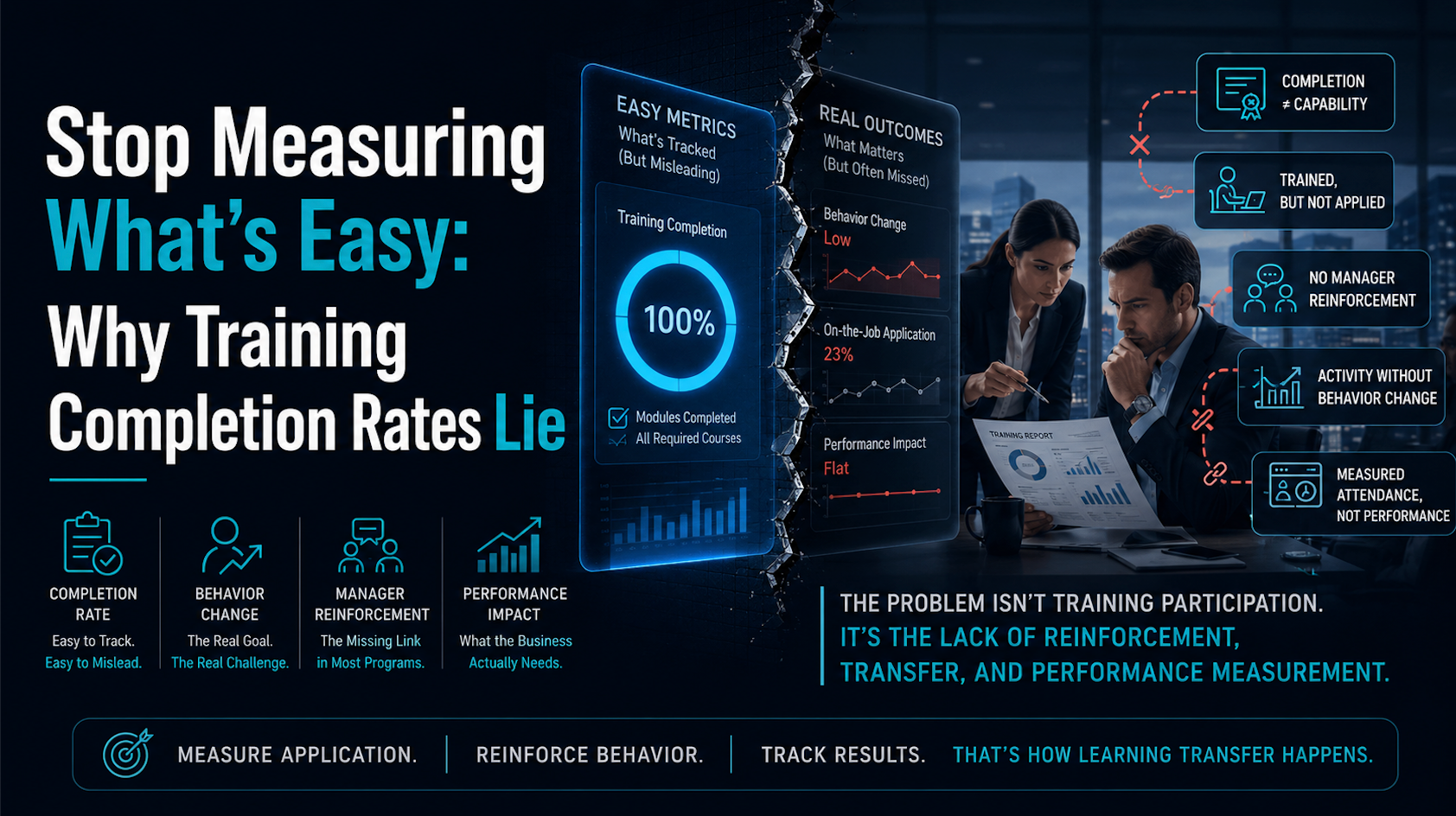
Stop Measuring What’s Easy: Why Training Completion Rates Lie
By Dr. Reggie Padin, Aimpro + ExpandPro · June 14, 2026
Most mid-market organizations are celebrating the wrong metric. Training completion rates hit 85%, leadership development programs wrap with glowing feedback scores, and compliance modules show 100% participation. Meanwhile, actual workplace behavior barely shifts, performance metrics flatline, and managers wonder why their $200,000 training investment produced no measurable change.
The problem isn't the training content. It's that completion is not conversion. When your systems teach one behavior but reward another, employees complete the program and then do what gets them promoted—which is usually not what they just learned.
The reinforcement gap that kills ROI
Training programs that teach behaviors managers don't subsequently coach are reinforcement failures, not knowledge failures [Contradiction-index-methodology-2026.S3]. This Teaching↔Reinforcement contradiction is one of the most expensive blind spots in mid-market organizations, typically degrading Training Completion Efficacy, Behavioral Change, Manager Effectiveness, and Learning-to-Performance Conversion across the board [Contradiction-index-methodology-2026.S4].
Consider the most common example: sales training teaches consultative selling and discovery questioning, but managers coach pipeline velocity and pitch refinement. Reps complete the program, understand the concepts, and then optimize for what their manager actually measures in weekly 1:1s. The completion rate shows success; the revenue-per-rep metric shows the truth.
Or leadership training that teaches delegation and team development, while the organization's visible culture rewards individual heroic performance. New managers complete the modules, then immediately revert to doing the work themselves because that's what gets noticed, praised, and promoted.
The cost compounds because organizations interpret high completion rates as training success, then scale broken programs. They measure activity instead of outcome, volume instead of impact.
What your completion metrics are hiding
High training completion rates can actually mask systemic dysfunction. When completion is the goal, employees optimize for completion—clicking through modules, attending sessions, passing assessments—without the cognitive load of behavior change. The metric becomes its own end rather than a proxy for the outcome you actually want.
More revealing: organizations with severe Teaching↔Reinforcement contradictions often show higher completion rates than coherent organizations, because completion becomes a substitute for performance rather than a precursor to it. It's easier to finish a training than to change how you work, especially when changing how you work conflicts with how you get rewarded.
Mid-market organizations typically incur $500,000-$2,000,000 annually in costs driven by contradictory signals between workforce systems, and most of these costs are invisible to executives [Contradiction-index-methodology-2026.S1]. Training contradiction costs show up as: training budgets that produce no performance lift, initiatives that require repeated launches, and cynical workforces that treat professional development as box-checking rather than capability building.
The system coherence test
Organizational performance is ceiling-capped by system coherence rather than individual subsystem quality—skilled, motivated workers in incoherent systems still produce mediocre collective output [CUSTOM-contradiction-index-methodology-2026.S2]. Your training effectiveness is limited not by instructional design but by whether the broader system supports the trained behavior.
The diagnostic question isn't "Did people complete the training?" but "Do the trained behaviors appear in daily work, get reinforced by managers, align with performance metrics, and connect to advancement criteria?" When these elements contradict each other, completion rates become meaningless vanity metrics.
Testing system coherence requires measuring contradictions across five dimensions: Strategy↔Execution, Promise↔Training, Measurement↔Reward, Teaching↔Reinforcement, and Policy↔Practice [Contradiction-index-methodology-2026.S1]. Each dimension affects specific performance outcomes predictably. Teaching↔Reinforcement contradictions specifically damage the training ROI most organizations assume they're getting from high completion rates.
Beyond completion: measuring what matters
Instead of celebrating completion, measure conversion. Track whether trained behaviors appear in performance reviews, 1:1 discussions, and daily workflow. Survey managers on what they're coaching six weeks post-training. Compare performance metrics before and after, not knowledge retention scores.
Most critically, measure the contradiction cost. Calculate what you're losing when systems teach one behavior but reinforce another. A meaningful reduction in organizational contradiction following targeted intervention is typically 15-25 points over 9-12 months [Contradiction-index-methodology-2026.S5]. Smaller improvements may reflect measurement noise rather than real systemic change.
The organizations that see actual training ROI aren't the ones with the highest completion rates. They're the ones whose training programs, manager behaviors, performance metrics, and advancement criteria all point in the same direction. Coherent systems compound training investment; contradictory systems neutralize it.
Stop measuring what's easy. Start measuring what matters: whether your people do tomorrow what they learned today.