
Newsletter / Reports
Performance Reviews That Go Nowhere
By Dr. Reggie Padin, Aimpro + ExpandPro · October 16, 2026
If your 2027 performance process still ends with a rating, you do not have a performance system. You have an evaluation process.
Every year, organizations invest enormous amounts of time in performance reviews.
Managers prepare evaluations. Employees complete self-assessments. Ratings are discussed. Goals are written. Development opportunities are identified.
Then January becomes February.
February becomes March.
And much of what was discussed during the performance review quietly disappears.
The employee returns to work.
The manager returns to managing.
The development plan sits somewhere in the HR system.
The training platform exists somewhere else.
Goals are tracked in another application—or sometimes in a spreadsheet.
Coaching conversations happen informally, if they happen at all.
By the time the next review cycle arrives, everyone is essentially starting over.
That is not a performance-management problem.
It is a systems problem.
And organizations preparing for 2027 should be addressing it now.
A Rating Is Not Development
Performance reviews are supposed to improve performance.
Yet many review systems are designed primarily to document performance rather than develop it.
There is an important difference.
A manager may tell an employee:
You need to improve your leadership skills.
That may be accurate.
But what happens next?
Does the employee receive a specific development pathway?
Is appropriate training automatically assigned?
Does the manager know how to coach the employee against that development goal?
Are there milestones?
Is progress measured?
Is there an opportunity to demonstrate the new capability?
Does the system prompt the manager and employee to revisit the goal?
If the answer is no, then the organization has identified a performance gap without creating a mechanism for closing it.
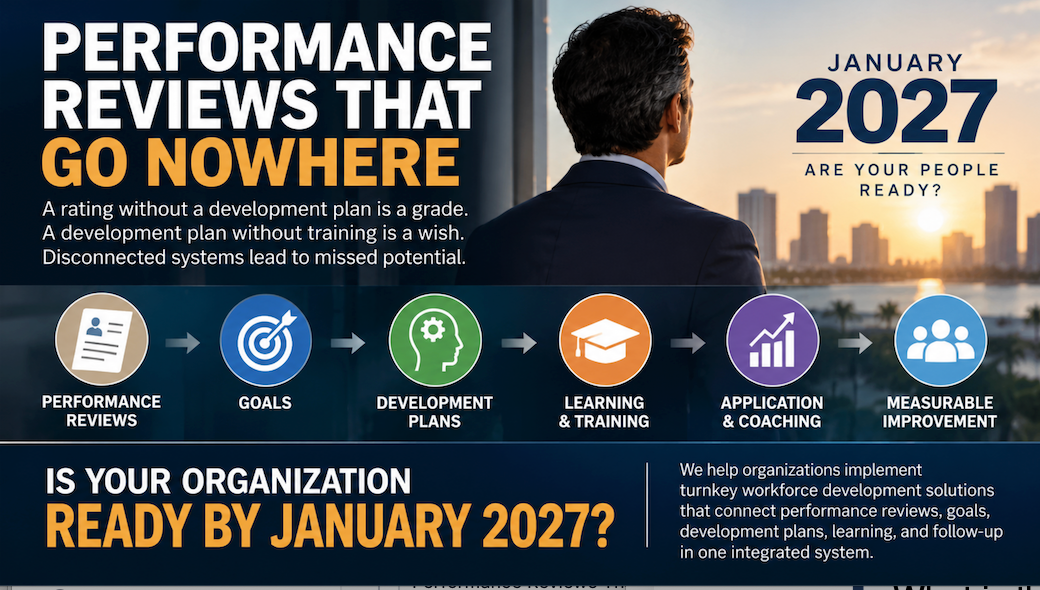
A rating without a development plan is a grade.
A development plan without training is a wish.
Training without reinforcement is an event.
And goals without follow-up are simply intentions.
The value comes from connecting all of them.
The Problem Is Fragmentation
Most organizations already have many of the pieces.
They may have:
- A performance-management system
- An LMS
- Goal tracking
- Compliance training
- Leadership development
- Employee surveys
- Coaching programs
- Recognition systems
- Competency models
- Career-development resources
The problem is that those pieces often operate independently.
The performance system knows an employee needs development.
The learning system has the course that could help.
The manager knows what improved performance should look like.
The employee has goals.
HR has competency frameworks.
Leadership has strategic priorities.
But the systems rarely communicate effectively with one another.
So employees experience development as a collection of disconnected activities rather than a coordinated path toward better performance.
That fragmentation creates unnecessary work for managers and HR teams.
It also makes it much harder for leadership to answer a basic question:
Are our development investments actually improving workforce capability?
What a Connected System Should Look Like
Imagine a different performance conversation.
A manager sits down with an employee and says:
Here is where you are.
The performance review identifies the employee's current performance and capability level.
Here is where you need to improve.
The review connects the performance gap to a clearly defined competency or skill.
Here are the goals we are setting.
The employee and manager establish measurable development and performance goals.
Here is the learning that will help close the gap.
Relevant courses, practice activities, resources, coaching, and development experiences are connected directly to the goal.
Here is how you will apply it.
The employee practices the skill in the actual work environment.
Here is when we will check progress.
The manager receives prompts for follow-up conversations and coaching.
And here is how we will know whether it worked.
Progress is measured against the original performance expectation.
Now the system becomes:
### Performance Review ↓ ### Goals ↓ ### Development Plan ↓ ### Learning ↓ ### Coaching ↓ ### Application ↓ ### Measurable Improvement
That is what performance management was supposed to become.
Why January 2027 Matters
Many organizations will wait until January to begin thinking about their 2027 development strategy.
That is too late.
By then, annual goals may already be established.
Performance expectations may already be communicated.
Managers may already be conducting planning conversations.
Training calendars may already be set.
Budgets will have been allocated.
Employees will already be moving against their 2027 objectives.
If the infrastructure connecting performance, goals, development, and learning is not ready, the organization begins another year with the same fragmentation.
Then leadership spends Q1 trying to redesign a system employees and managers are already using.
Organizations that want a different result in 2027 need to begin building the infrastructure before 2027 begins.
The goal should be simple:
Enter January with the system ready—not with a project to build the system.
This Is Becoming More Important Because Work Is Changing Faster
The traditional annual-review model was already struggling.
AI, automation, changing roles, evolving skills, and new productivity expectations are making the problem more obvious.
An employee's development needs may change several times during the year.
New technology may alter how the work is performed.
A role may require capabilities in 2027 that were barely relevant in 2025.
Managers therefore need something more dynamic than an annual rating.
They need visibility into:
- Current capability
- Required capability
- Development priorities
- Learning activity
- Goal progress
- Performance evidence
- Coaching activity
- Readiness for future roles
That moves performance management from an administrative HR process toward a workforce capability system.
And I believe that distinction will become increasingly important during 2027 and 2028.
Managers Should Not Have to Assemble the System Themselves
One of the hidden problems with fragmented performance systems is the burden placed on managers.
Consider what we often expect a manager to do.
Conduct the review.
Interpret the competency gap.
Create the development plan.
Find appropriate training.
Determine whether the training is relevant.
Schedule coaching.
Remember to follow up.
Track progress.
Document improvement.
Recognize good performance.
Report everything back to HR.
That is a lot of disconnected work.
And when managers are already responsible for operations, customers, projects, budgets, and people, development understandably falls behind.
Technology should reduce that burden.
The manager should be able to see:
Performance gap → recommended development → learning → employee progress → follow-up
without jumping between multiple systems.
The easier development is to manage, the more likely it is to happen.
The Opportunity for 2027
This is why I believe organizations should reconsider the way they purchase HR and learning technology.
The question should no longer be:
Which LMS should we buy?
Or:
Which performance-review platform should we use?
Or:
Which goal-tracking application do we need?
The better question is:
What infrastructure do we need to move an employee from performance feedback to measurable improvement?
That may include:
- Learning management
- Performance reviews
- Goal tracking
- Development planning
- Competency management
- AI-enabled coaching
- Social learning
- Employee recognition
- Gamification
- Content management
- Compliance tracking
- Surveys
- Career development
- Manager dashboards
- Reporting and analytics
But the value does not come simply from having those features.
The value comes from connecting them around employee capability and business performance.
That Is What We Are Building for Organizations
We are helping organizations prepare for 2027 with turnkey workforce-development ecosystems designed to connect these functions rather than leave them operating as separate systems.
The idea is straightforward:
Instead of purchasing a performance platform from one vendor, an LMS from another, goal tracking somewhere else, recognition somewhere else, and then trying to make everything work together—
build the environment as one connected workforce-development system.
Performance reviews can identify the gap.
Goals establish the destination.
Development plans define the path.
Learning builds the capability.
Coaching reinforces it.
Recognition supports progress.
Measurement determines whether performance actually improved.
That is a very different operating model from simply having several HR applications.
The Question Leaders Should Ask Before 2027
As organizations prepare their workforce plans, budgets, and priorities for the coming year, I would encourage leadership teams to ask one question:
What actually happens after one of our managers identifies a performance or capability gap?
Follow the process.
If the answer requires five systems, three spreadsheets, several emails, and a manager remembering to follow up six months later, there is probably an opportunity to improve the infrastructure.
If the process stops at the performance review, there is an even larger problem.
The organizations that get this right will not simply conduct better reviews.
They will become better at turning feedback into capability.
And capability into performance.
January Is Closer Than It Looks
2027 should not begin with another round of disconnected performance reviews.
Organizations have an opportunity right now to put the infrastructure in place so that the next review creates action rather than documentation.
The objective is not to create more HR administration.
It is the opposite.
Create a system where managers and employees can clearly see:
Where you are. Where you need to go. What will help you get there. What progress looks like. And whether the development actually worked.
That is where performance management becomes workforce development.
And that is where workforce development starts producing measurable business value.
If your organization wants this infrastructure operational by January 2027, now is the time to build it.