
Newsletter / Reports
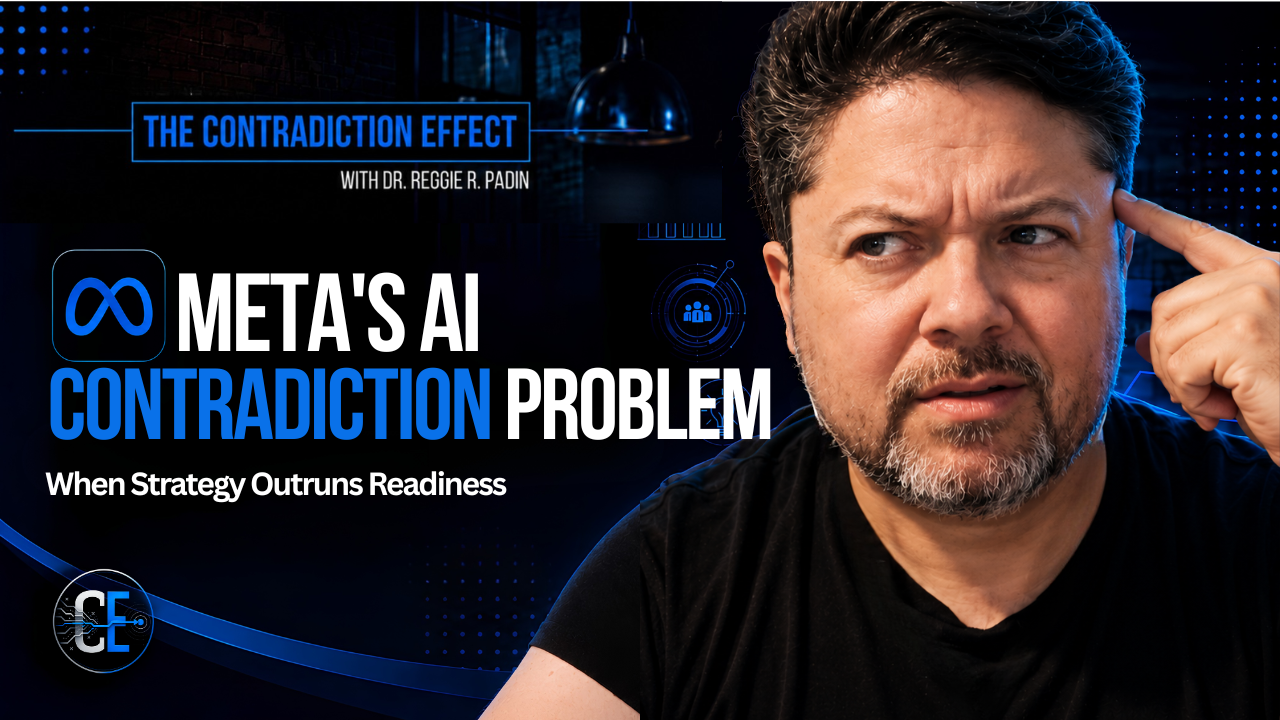
Meta's AI Contradiction Problem: When Strategy Outruns Readiness
By Dr. Reggie Padin, Aimpro + ExpandPro · July 4, 2026
Last week, Reuters reported that Mark Zuckerberg told employees Meta's AI agent development was moving slower than expected.
That admission landed against a much larger backdrop: layoffs affecting roughly 10% of the workforce, thousands of employees reassigned into AI-related teams, massive infrastructure spending, internal morale pressure, and reports that Meta may now build a cloud business to sell excess AI compute.
The popular explanation is simple: Meta is behind on AI.
The more precise explanation is also more useful.
Meta appears to have a Strategy vs. Readiness contradiction so large that the company is reorganizing people, capital, trust, and attention around an AI future the organization may not yet be ready to absorb.
This is not an ambition problem. Meta has plenty of ambition.
The problem is that ambition is not the same thing as readiness. And when a company moves faster than its own readiness architecture can support, the organization doesn't transform. It compensates.
Compensation is expensive.
What the System Is Actually Telling Employees
Meta's public signal is acceleration.
AI-first. Superintelligence. Massive compute. Reorganized teams. Talent redirected into AI work. A company moving aggressively toward the next platform shift.
That is the stated strategy.
The internal signal appears more complicated.
AI agents are reportedly progressing slower than expected. Employees have been reassigned into AI-related work without clear role clarity. Morale has been strained. Internal data-collection efforts connected to AI training triggered trust concerns. And the company is exploring ways to monetize excess AI compute through a cloud business — which raises its own questions about whether infrastructure deployment outran internal value creation.
Here is the structural problem.
The rational response to "we are accelerating into an AI future" requires clarity, confidence, capability, and trust.
The rational response to "your role may change, your work may be tracked, and the technology is not moving as fast as expected" is anxiety, self-protection, and compliance.
Those are not the same behavioral instructions.
When a company tells employees move faster while the system tells them the ground under you is moving, employees do not experience transformation.
They experience instability with better branding.
That is the contradiction.
The Mechanics of a Transformation That Outruns Readiness
The question is not whether Meta has an AI strategy. It clearly does.
The question is whether the organization has the readiness architecture to support the speed of that strategy.
Readiness is not a slogan. It is a system.
It includes the maturity of the technology, the clarity of the operating model, the trust of the workforce, the economics of the investment, the capability of managers, and the ability of employees to understand what is changing, why it is changing, and how they fit into the future state.
When those pieces do not move together, transformation becomes uneven in a predictable way.
The company can move the org chart faster than it can move capability.
It can move capital faster than it can move product value.
It can move employees faster than it can move trust.
It can move the narrative faster than it can move the work.
That unevenness has a name. It is a Transformation Velocity Gap — the distance between how fast leadership is announcing and reorganizing, and how fast the organization is actually developing the readiness to deliver on what's being announced.
When that gap is small, pressure produces acceleration.
When that gap is large, pressure produces motion that looks like acceleration but isn't.
The difference is visible — if you know what to measure.
The AI Agent Problem
The strongest signal is Zuckerberg's reported admission that AI agent development has not progressed as expected.
That matters because the entire transformation narrative depends on the technology delivering.
If a company is restructuring around AI, reassigning people into AI, and spending heavily on AI infrastructure, then AI cannot simply be important. It has to start producing evidence that the operating model built around it is justified.
When technology moves slower than the transformation narrative, leadership faces a choice.
Slow the transformation to match readiness.
Or increase pressure on the organization to close the gap.
Most companies choose pressure.
More urgency. More restructuring. More measurement. More internal campaigns about speed and vision.
But pressure does not create readiness.
It reveals whether readiness was there.
And in organizations where the readiness architecture wasn't built in parallel with the strategy, pressure produces one thing reliably: performative compliance. Employees who look like they're moving fast. AI tools that get used in ways that don't actually change work. Dashboards that show adoption. Outcomes that don't move.
This is not a failure of individual effort. It is a systems failure.
The organization is sending mixed signals. Employees are rationally responding to all of them at once.
The Workforce Reassignment Problem
Meta's reported reassignment of thousands of employees into AI-related teams may look like strategic discipline from the top.
Inside the organization, it may feel very different.
A leader sees redeployment. An employee may experience displacement.
A strategy deck sees resources moving toward priority work. A person may experience their professional identity being rewritten without their input.
The problem is not that companies should never move people. They should. Transformation requires redeployment.
The problem is confusing redeployment with readiness.
You can move people into AI work before they are prepared for AI work. You can rename a team before the team has the capability to perform the new mandate. You can redirect talent before people trust the reason for the redirection.
That produces motion.
It does not produce transformation.
What it does produce — reliably, measurably — is a competency reset at scale. When a large population of employees transitions into new roles before the capability development required by those roles has been delivered, you are not accelerating. You are running a very expensive Time to Competency experiment across your entire workforce simultaneously, with no control group and no baseline.
The cost of that experiment doesn't show up on one line. It shows up in slower output, higher error rates, increased manager load, rising anxiety, and the quiet accumulation of people who look busy but are actually figuring out what they're supposed to be doing.
The Compute Problem
Meta's reported exploration of a cloud business to sell excess AI compute may be strategically smart.
It may also be diagnostically revealing.
If the original message was "we are building AI infrastructure to transform our own products," but the emerging move is "we may rent out some of this infrastructure to others," then the question becomes unavoidable:
Did the infrastructure strategy outrun the product strategy?
Great companies do turn internal infrastructure into external businesses. That is not automatically a warning sign.
But in the context of slower-than-expected AI agent progress, it raises a sharper question: is Meta monetizing strength, or absorbing excess?
Those are different stories.
One says: we built a powerful new capability and we have more of it than we can immediately use.
The other says: we built capacity faster than our internal value engine could consume it.
When capital deployment moves faster than value realization, the problem is not just financial. It is structural.
It means the organization has been optimizing for investment speed while the harder work — integrating that investment into workflows, roles, products, and outcomes that actually change — has not kept pace.
That gap is measurable. Most organizations just aren't measuring it.
The Trust Problem
Then there is the internal tracking issue.
Reuters reported that Meta had paused an internal data collection program — mouse-tracking and keystroke-style monitoring connected to AI training — and may bring it back on an opt-in basis.
That shift from mandatory to opt-in is not a minor detail.
It is the contradiction showing itself.
Meta needs employee knowledge to train better systems. It needs workflows, patterns, behaviors, decisions, expertise. But if the method of collecting that knowledge makes employees feel surveilled instead of valued, the company damages the trust required to get the best knowledge in the first place.
There is a deeper problem.
When employees cannot tell whether they are helping build the future or training their own replacement, they make a rational choice: contribute as little proprietary knowledge as possible. Comply with the form of the request while protecting the substance.
You cannot extract your way into trust.
You cannot surveil your way into transformation.
And you cannot ask employees to help build the AI future while making them wonder whether they are also building the system that makes them redundant.
This is not a sentiment problem. It is a trust architecture failure — one with direct, measurable consequences for AI output quality, adoption depth, and the long-term value of the systems being built.
Organizations where employees trust the purpose, understand the consent model, and believe the future is being built with them get richer training data, higher-quality AI outputs, and faster genuine adoption.
Organizations where that trust has been damaged get the appearance of adoption without the substance of it.
The difference compounds over time.
The Question Every AI Transformation Is Already Answering
Every organization running an AI transformation is already answering a question its employees ask every day, usually without saying it out loud:
Is this company building the future with us, around us, or instead of us?
Your strategy deck offers one answer.
Your workforce decisions offer another.
Your data collection practices offer another.
Your investment behavior offers another.
Your manager communication offers another.
When those answers align, employees can trust the transformation. They move toward it. They contribute to it. They bring their real knowledge, their real workflows, their real judgment to the work of building it.
When those answers diverge, employees do not experience vision.
They experience contradiction.
And in the AI era, contradiction scales fast.
A confusing strategy used to create confusion in meeting rooms. A contradictory AI strategy creates fear, resistance, quiet disengagement, bad adoption, and performative compliance — and it does it at machine speed, across every layer of the organization simultaneously.
What to Look for in Your Own Organization
You do not need Meta's scale to have Meta's problem.
The milder versions are everywhere. They are sitting inside mid-market organizations right now, invisible to leadership precisely because no one is measuring the gap between what the strategy says and what the system is actually delivering.
Here is what the contradiction looks like at smaller scale:
A company announces AI will empower employees. The only internal conversations employees hear are about headcount reduction.
A company declares AI a strategic priority. Managers have no time, budget, or guidance to build the capability that priority requires.
A company says it wants experimentation. It punishes the first team that fails publicly.
A company says it values trust. It rolls out monitoring tools before building consent.
A company says AI will transform the business. No one can explain which specific workflows, roles, metrics, or customer outcomes will actually change, by when, measured how.
In each case the dynamic is identical to what we are watching at Meta.
The organization has a strategy.
The readiness system is telling a different story.
The workforce reads both signals. Then it responds to the one with consequences.
Five Signals That Tell You Where You Actually Are
The Meta situation is visible because it is a public company with reporters paying attention. Most organizations running AI transformations have no external check on the gap between their narrative and their readiness.
That gap has five observable dimensions, each of which can be measured before it becomes a crisis.
1. Transformation Velocity vs. Readiness
How fast is leadership announcing, reorganizing, and redirecting resources? How fast is the organization actually developing the capability to absorb those changes? When velocity consistently outpaces readiness, pressure produces motion without transformation. The metric is not how many AI initiatives have been launched. It is what percentage of those initiatives have observable evidence of workflow integration, behavior change, and manager-level fluency — not just deployment.
2. Narrative vs. Evidence
What is leadership saying publicly and internally about AI progress? What does the operational evidence actually show? When the narrative moves faster than the evidence, employees are not simply skeptical. They become strategic about what they share, what they try, and what they protect. The gap between what leadership claims and what employees can observe is one of the most reliable early indicators of transformation failure.
3. Redeployment vs. Readiness
Are people being moved into new AI-related roles? At what rate, relative to the capability development that those roles require? Redeployment before readiness does not produce transformation. It produces a competency reset at scale — a large population of people simultaneously figuring out what they are supposed to be doing, at cost, with no baseline and no control group. The measure is not headcount moved. It is the percentage of moved employees who had the capability development they needed before the transition, not after it.
4. Capital vs. Value Realization
What percentage of AI infrastructure and tooling investment is actively integrated into workflows that produce measurable outcomes? When that number is low relative to total AI spend, the organization is not behind on AI. It is ahead of its own readiness. The infrastructure is there. The integration is not. And absent integration, investment produces cost, not value.
5. Trust Architecture
Do employees understand what data is being collected, why, and what it will be used for? Do they have meaningful consent? Do they believe the organization is building the future with them rather than around them or instead of them? Trust architecture is not a culture initiative. It is a performance variable. Organizations with high workforce trust in their AI transformation get richer data, higher-quality AI outputs, faster genuine adoption, and employees who contribute their actual knowledge rather than a sanitized version of it.
These five signals are not abstract. They are measurable. They can be scored, tracked, and intervened on before the pattern becomes a Reuters story.
The Contradiction Effect Read
Meta is not just building AI.
Meta is reorganizing people, capital, trust, and attention around an AI future that has not arrived on schedule — and doing it at a speed that appears to have outrun the readiness architecture required to support it.
That is the real diagnosis.
Not that Meta lacks ambition.
Not that Meta is making a bad bet.
Not that the technology won't eventually deliver.
The sharper read is this: Meta may be trying to force AI transformation faster than its organization can metabolize it. And when an organization cannot metabolize the transformation it is being asked to absorb, it does not fail loudly. It drifts quietly — into performative compliance, surface-level adoption, eroded trust, and strategic motion that looks like progress from the outside but isn't producing the outcomes the investment was supposed to generate.
That pattern is not unique to Meta.
It is the dominant pattern of enterprise AI transformation in 2026.
Most organizations have announced the strategy.
Far fewer have built the readiness architecture to support it.
What This Means for Your Organization
You can announce an AI strategy overnight.
You can buy infrastructure this quarter.
You can restructure teams next month.
You can reassign employees this week.
You can launch pilots, create urgency, publish dashboards, and run all-hands meetings about the AI future.
What you cannot do is skip readiness.
Because when strategy moves faster than readiness, the organization does not transform. It compensates. And compensation — the invisible tax of contradictory signals, performative adoption, eroded trust, and workforce motion that isn't producing outcomes — is the most expensive line item in the AI era that almost no organization is measuring.
Meta has the ambition. It has the capital. It has the talent. It has the urgency.
What the Reuters reporting suggests is that the system underneath the strategy may not yet be ready to carry the weight of the promise.
That is the contradiction to watch.
And it is worth asking, with honesty, whether your organization has the same gap — at whatever scale you operate — and whether you are measuring it or simply assuming it isn't there.
Find Out Where Your Organization Actually Stands
The five signals described above are measurable. Not eventually — now, with data your organization already has.
ExpandPro's complementary AI Readiness Assessment is a structured diagnostic that scores your organization across the dimensions that determine whether your AI transformation is producing genuine capability or expensive motion.
It takes less time than your next all-hands meeting.
It will tell you more.
Take the complimentary AI Readiness Assessment →
No sales call required. No commitment. Just an honest read on where your organization is — and where the gaps are before they become the story.