
Newsletter / Reports
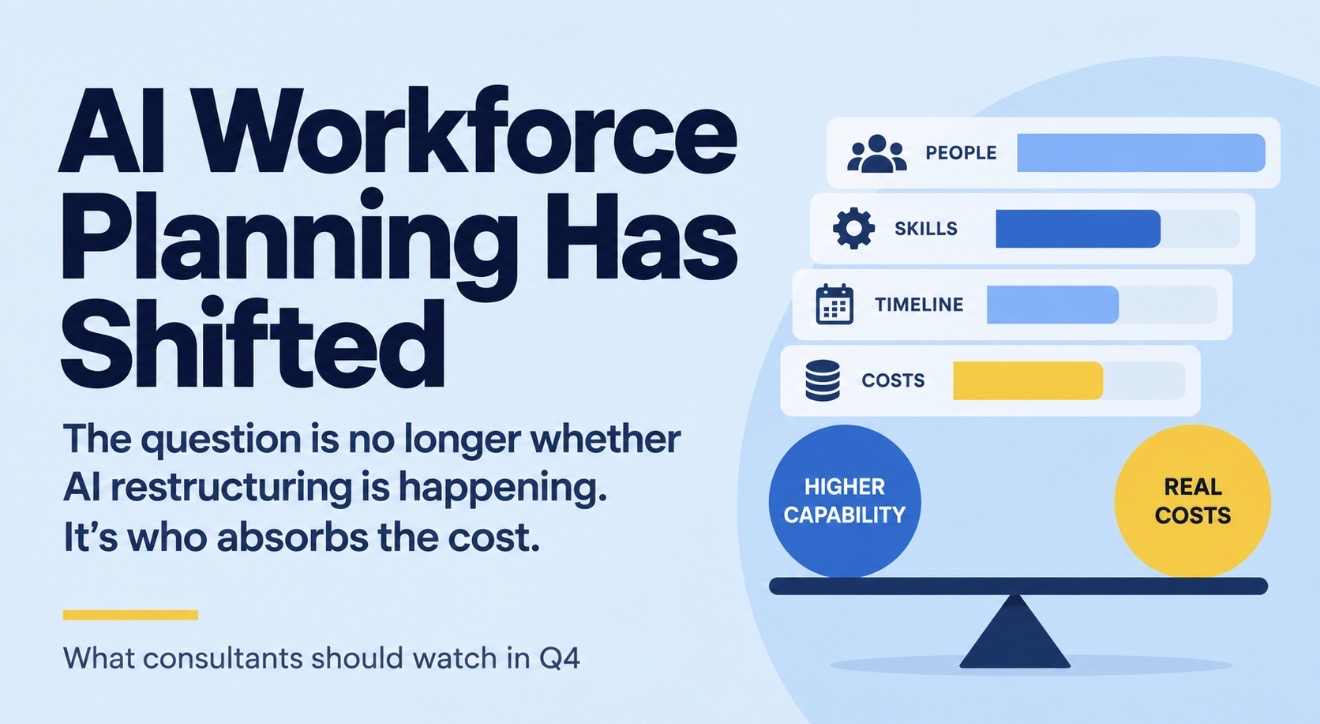
AI Workforce Planning in 2026 Has Moved to a More Uncomfortable Question
By Dr. Reggie Padin, Aimpro + ExpandPro · September 21, 2026
For months, the conversation was:
Will AI restructure the workforce?
That question is becoming less useful.
The question I’m hearing underneath Q4 planning now is:
Who absorbs the cost of that restructuring?
Gartner’s nine-trend CHRO framework and McKinsey’s agent-skill partnership model have been circulating long enough that many leadership teams are no longer treating AI-driven restructuring as an open question.
They’re treating it as planning permission.
And that creates a different kind of risk.
What the signals are starting to show
Look at the stories together:
- Gartner: workforce models are changing around AI, skills and organizational design.
- McKinsey: human capability still has to develop alongside AI agents.
- Yale: the pressure on entry-level pathways deserves serious attention.
- SQ Magazine: 2026 job-loss data keeps the displacement question front and center.
- SHRM and HCA Magazine: job-loss numbers alone don’t tell the entire workforce story.
- Berkeley Labor Center: regulation is developing unevenly across jurisdictions.
- The Conversation: job design—not merely headcount reduction—is becoming part of the real retention issue.
Separately, these are workforce trends.
Together, they point to a contradiction.
The emerging contradiction
Companies can reduce externally visible labor costs today while allowing internal capability gaps to accumulate tomorrow.
That can look financially rational in the short term.
But consider the tradeoff:
Reduction-first approach → Lower immediate headcount → Fewer entry-level roles → Deferred capability investment → Smaller future talent pipeline
Redesign-first approach → Identify work AI can actually absorb → Redesign remaining roles → Build the required skills → Replace lost entry pathways intentionally
Those are not the same workforce strategy.
A simple Q4 test
If a 2026 workforce plan cites Gartner, McKinsey or SHRM, I would look for three things immediately:
- What specific regulatory exposure has been identified? Not “AI regulation is evolving.” Which exposure, in which jurisdiction, affecting which workforce decision?
- What replaces the entry-level talent pipeline being reduced? If junior roles disappear, where will experienced talent come from three to five years from now?
- Who owns job redesign? Not the communications plan. Not the reskilling announcement. The actual redesign of workflows, decision rights, skills and management expectations.
If those answers are missing, the organization may not have an AI workforce strategy yet.
It may have a headcount strategy wrapped in an AI narrative.
And that distinction is going to matter a lot more as companies finalize their 2027 workforce plans.
For consultants working through Q4 planning right now: I’d add these three questions to every workforce review before accepting “AI transformation” as the rationale for restructuring.