
Newsletter / Reports
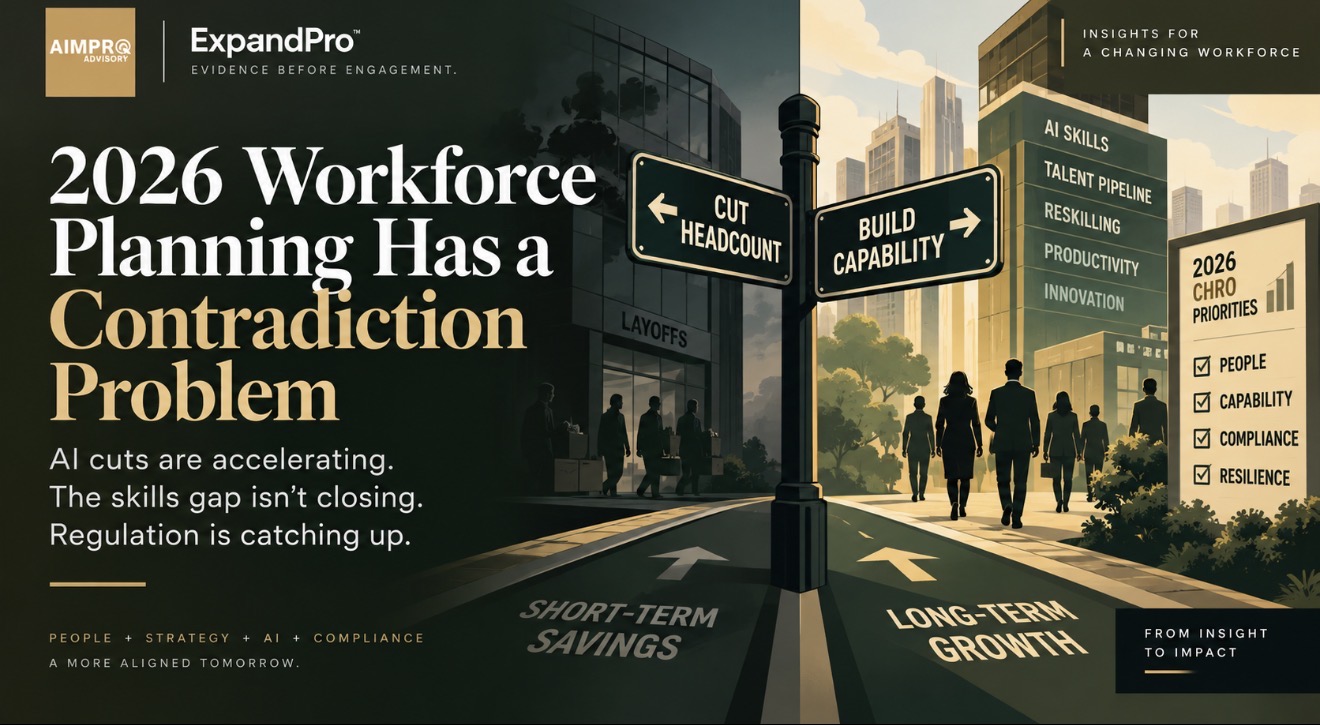
2026 Workforce Planning Has a Contradiction Problem
By Dr. Reggie Padin, Aimpro + ExpandPro · September 14, 2026
Gartner just published its 2026 CHRO priorities.
But there is a problem underneath the recommendations:
Companies are trying to reduce headcount and build AI capability at the same time.
For mid-market organizations, those two decisions are beginning to collide.
Companies Are Cutting the People They Need to Reskill
Tech layoffs are accelerating in 2026.
At the same time, employers continue to report difficulty closing the AI skills gap.
That creates a structural contradiction:
- Reduce headcount.
- Increase AI capability.
- Redesign jobs.
- Expect the remaining workforce to absorb the change.
- Maintain productivity while the organization learns new ways of working.
Those objectives can coexist.
But only when the workforce architecture underneath them has been deliberately redesigned.
For many companies, it hasn’t.
McKinsey’s Human + AI Model Requires a Human Foundation
McKinsey’s emerging model of people working alongside AI agents and automation makes sense.
But there is an important prerequisite:
The organization still needs people capable of partnering with the technology.
That means companies need:
- AI literacy
- role-specific capability
- management reinforcement
- redesigned workflows
- updated performance expectations
- new decision rights
- incentives aligned with the new operating model
Automation does not eliminate the capability problem.
In many cases, it makes the capability problem more important.
Yale and AIMultiple Point to an Upstream Talent Problem
There is another constraint developing earlier in the talent pipeline.
Research from Yale and AIMultiple is examining the effects of AI on entry-level employment.
That matters because entry-level jobs are not just inexpensive labor.
They are the beginning of the future talent pipeline.
Today’s junior employee becomes tomorrow’s:
Analyst → Manager → Director → Executive
If fewer people enter that pipeline in 2026, the impact may not become fully visible for several years.
But the constraint begins now.
Organizations could eventually discover that they eliminated the very developmental layer they expected to supply their future managers and specialists.
Gartner’s Capability Strategy Meets a Different Operational Reality
This is where the tension becomes important.
The traditional assumption
Organizations can:
- Identify emerging skills.
- Recruit for those skills.
- Develop existing employees.
- Redesign roles.
- Deploy AI.
- Measure productivity improvements.
The emerging reality
Organizations are simultaneously:
- reducing headcount,
- eliminating junior roles,
- redesigning jobs,
- introducing AI agents,
- struggling with AI capability,
- and navigating changing employment regulation.
That is a very different workforce problem.
It is no longer simply learning and development.
It is workforce architecture.
Berkeley Highlights the Constraint Consultants Should Watch
For consultants helping clients finalize Q4 2026 workforce plans, the Berkeley policy work on AI governance may be one of the most important signals to watch.
AI regulation remains fragmented.
That changes how organizations should think about workforce restructuring.
A role-elimination or job-redesign document increasingly needs to function as two things at once:
A skills architecture
It should explain:
- what work is changing,
- which capabilities are still required,
- what AI will perform,
- what humans will perform,
- and how the redesigned role creates value.
A pre-compliance record
It should also document:
- why the role changed,
- how the decision was made,
- what technology influenced the redesign,
- which criteria were used,
- and how workers were affected.
Those two documents probably should not be developed separately anymore.
A Simple 2026 Decision Test
Before recommending another workforce reduction, ask four questions:
1. Capability: Are we eliminating capability we will need to rebuild later?
2. Pipeline: Are we removing entry-level positions that feed future leadership or specialist roles?
3. AI readiness: Can the remaining workforce actually operate in the human + AI model we are designing?
4. Governance: Could we clearly explain and document why each role was eliminated, redesigned, augmented, or automated?
If the answer to any of those is unclear, the organization may be moving faster than its workforce architecture can support.
The Bigger Contradiction
The real contradiction of 2026 may not be:
AI versus jobs.
It may be this:
Companies are simultaneously trying to remove human capacity and increase human capability.
That can work.
But it requires much more deliberate workforce design than simply cutting positions and purchasing AI tools.
For consultants advising clients on restructuring this quarter, that is the constraint worth pressure-testing before the organizational chart changes.
#FutureOfWork #TalentStrategy #AIGovernance #WorkforceStrategy #ArtificialIntelligence #LearningAndDevelopment #OrganizationalDesign