
Newsletter / Reports
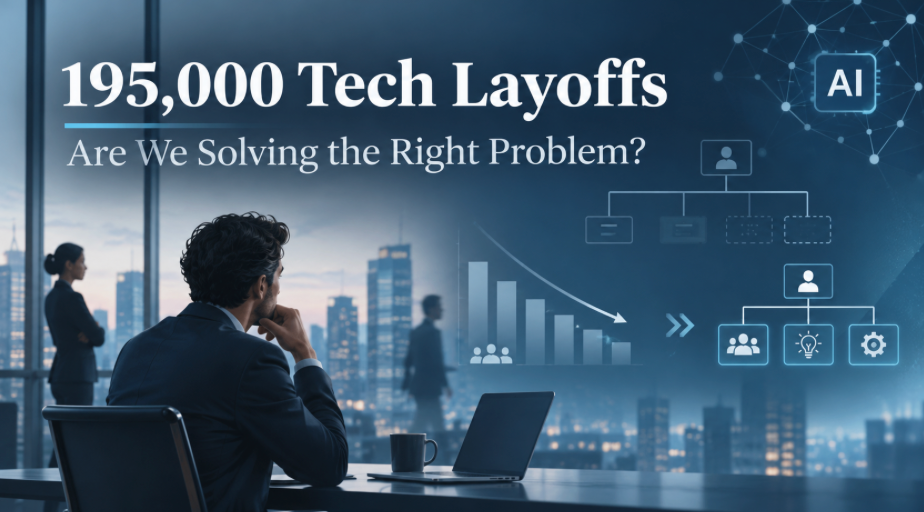
195,000 Tech Layoffs. Are We Solving the Right Problem?
By Dr. Reggie Padin, Aimpro + ExpandPro · November 4, 2026
As companies restructure around AI, I wonder how many are thinking seriously about the workforce they'll need on the other side.
More than 195,000 technology workers have lost their jobs in 2026. Amazon, Microsoft, Meta, Oracle, Salesforce, Intel, Uber, and dozens of other companies have announced layoffs, reorganizations, or significant changes to their workforce.
Some of these decisions are directly related to artificial intelligence. Others are driven by costs, changing business priorities, or disappointing financial performance. In many cases, it's probably a combination.
Whatever the reasons, I find myself increasingly concerned about what happens after these reductions.
I've spent much of my career helping organizations develop people, build corporate universities, implement learning technologies, and connect workforce capabilities to business objectives. One thing I've learned is that changing an organizational structure is relatively straightforward. Changing how an organization actually operates is considerably more difficult.
And I suspect we're about to see that lesson play out on a much larger scale.
The workforce is changing faster than the organizations managing it.
Consider what's happening at some of these companies.
Oracle disclosed workforce reductions of approximately 21,000 positions over the previous year while making substantial investments in AI infrastructure. Monday.com reduced its workforce by roughly 20% as it repositioned its business around AI. ClickUp announced a 22% reduction while introducing significant compensation opportunities for employees capable of delivering exceptional results using AI.
These companies are making different business decisions, but they reflect a larger shift in how organizations think about productivity and the people required to deliver it.
For years, business growth and workforce growth were closely connected. Expanding operations generally meant hiring additional employees, developing more managers, and creating new departments.
That relationship is beginning to change.
Organizations are discovering that technology can perform work that previously required entire teams. Naturally, executives are reconsidering staffing models, management structures, and operating costs.
I don't think there's anything inherently wrong with that. Organizations have always adapted to technological change, and leaders have a responsibility to ensure their businesses remain competitive.
What concerns me is the possibility that we're becoming much better at identifying positions we no longer need than determining which capabilities we will need.
Those are two very different exercises.
We're eliminating positions while still figuring out how the new organization should function.
Imagine a company eliminates 15% of its workforce because leadership believes AI can improve productivity.
The savings appear immediately. The new organizational chart is approved, responsibilities are redistributed, and investors receive an encouraging update about improved operational efficiency.
But what happens six months later?
Are employees actually more productive, or are they simply managing larger workloads? Have managers learned how to lead teams where humans and AI systems share responsibility? Have performance expectations changed to reflect the new ways work is being performed?
And perhaps most importantly, has the company invested in developing the capabilities its remaining employees now need?
These questions aren't hypothetical management concerns. They are practical operational issues that determine whether a restructuring produces lasting improvements or simply transfers costs and responsibilities elsewhere.
I've seen organizations invest heavily in technology while providing relatively little attention to the people expected to use it. I've also seen impressive strategic plans fail because the systems responsible for executing them never changed.
AI doesn't eliminate those challenges. In some respects, it makes them more consequential.
A poorly designed process doesn't automatically become a good process because an AI agent is performing part of it.
And a workforce that lacks clarity, preparation, or effective leadership doesn't become more capable simply because it has access to better technology.
There's a contradiction developing in the way we approach workforce transformation.
This is particularly interesting to me because it connects directly to the research and organizational work behind my book, The Contradiction Effect.
One of the recurring problems I examine is the disconnect between what organizations say they want to accomplish and the systems they've established to accomplish it.
We see it when companies emphasize innovation but penalize experimentation. When leaders talk about employee development but reduce the resources available for learning. Or when organizations announce ambitious strategic priorities while continuing to reward behaviors that have little to do with those priorities.
AI is introducing another version of that problem.
Companies are telling employees that adaptability, continuous learning, and technological fluency will determine their future value. At the same time, some are reducing the very functions, resources, and development pathways that help employees acquire those capabilities.
Of course, not every organization is doing this, and not every workforce reduction represents a failure of strategy.
But the potential contradiction deserves attention.
If we expect fewer people to accomplish more sophisticated work, shouldn't the development of those people become an even greater priority?
If we're removing management layers, shouldn't we be reconsidering how decisions are made, how performance is supported, and how employees receive guidance?
And if AI is fundamentally changing the skills organizations need, shouldn't workforce planning and learning strategy be central to the transformation rather than activities addressed after the technology decisions have already been made?
I'm also concerned about the next generation of talent.
There's another issue that hasn't received nearly enough attention.
Much of the work organizations are automating or eliminating has historically provided an entry point for people beginning their careers.
Junior analysts, coordinators, administrative professionals, entry-level developers, and other early-career employees have traditionally learned through work that is now increasingly being automated.
Certainly, some of that work was repetitive. Some of it probably should have been automated years ago.
But those positions served another purpose. They allowed people to develop judgment, understand organizational systems, learn from experienced colleagues, and gradually assume greater responsibility.
If we eliminate significant portions of that experience, where will tomorrow's experienced professionals come from?
We may discover that we've improved short-term productivity while weakening our long-term talent pipeline.
This doesn't mean organizations should preserve unnecessary positions simply to maintain traditional career paths. It means we need to be much more intentional about creating new pathways for developing professional capability.
That responsibility cannot be delegated entirely to universities, training providers, or individual employees.
Employers have a role to play, particularly when they are the ones fundamentally changing the requirements of work.
What I would like to see leaders do differently in 2027
I would like to see more organizations approach AI transformation as a workforce design initiative rather than primarily a technology implementation or cost-reduction exercise.
Before deciding how many positions can be eliminated, determine how work should be performed in the future. Identify which responsibilities should remain with people, which can be supported by AI, and which can be automated entirely.
Then examine whether the organization is actually prepared to operate that way.
That includes reviewing job responsibilities, management expectations, decision-making authority, performance measures, employee development, and the incentives that influence behavior.
In my work, I examine these relationships through five areas of organizational contradiction: Strategy and Execution, Promise and Training, Measurement and Reward, Teaching and Reinforcement, and Policy and Practice.
They provide a useful way to examine whether the different parts of an organization are working toward the same objectives or unintentionally undermining one another.
For example, an organization might have an excellent AI strategy but continue evaluating employees using performance measures designed for an entirely different operating model.
Another might spend millions introducing AI tools while providing employees with little opportunity to develop the judgment and skills necessary to use them effectively.
These disconnects matter because technology investments don't operate independently of the organizations in which they're introduced.
The numbers we're not measuring
As we approach 2027, I expect we'll continue seeing headlines about layoffs, automation, restructuring, and the growing productivity potential of AI.
What I'd be interested in seeing are the numbers that follow.
How much of the anticipated productivity improvement actually materialized? What happened to employee engagement and retention? Did the remaining workforce develop the capabilities needed to sustain performance? Were customers better served? Did organizations become more adaptable, or simply smaller?
And perhaps the most revealing question: did the restructuring resolve existing organizational problems, or expose contradictions that had been there all along?
I'm not opposed to AI-driven restructuring. I believe AI offers extraordinary opportunities to improve how organizations operate, and I expect it to fundamentally change the workforce.
But eliminating positions and building a more capable organization are not necessarily the same thing.
My concern is that too many leaders may discover the difference only after the reductions have been made.
The companies worth watching in 2027 won't simply be those that learned how to operate with fewer employees. They'll be the ones that figured out how to make their people, technology, and organizational systems work better together.
That's a much more meaningful measure of transformation.
Dr. R. R. Padin is the author of The Contradiction Effect and works at the intersection of workforce strategy, organizational alignment, learning, and technology.
Interested in understanding where your organization's strategy and execution may be working against each other? Discover your Workforce Contradiction Index (WCI) score at https://wciscore.com.