
Newsletter / Reports
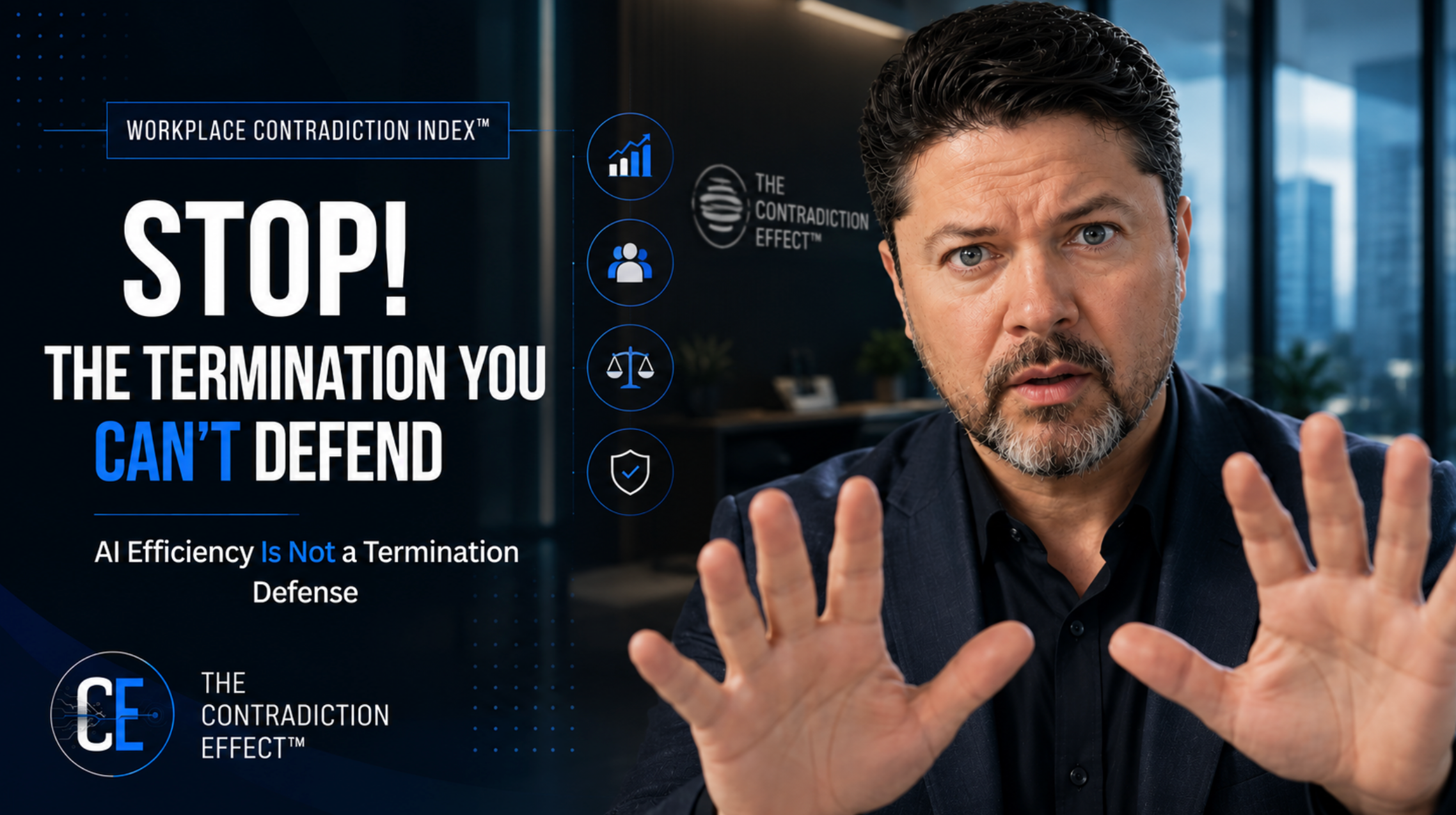
The Termination You Can't Defend: AI Efficiency Is Not a Termination Defense
By Dr. Reggie Padin, Aimpro + ExpandPro · July 6, 2026
A Chinese court just ruled that "AI made us more efficient" isn't a legal reason to fire someone. Most U.S. companies are making that exact case right now — with no paper trail.
Earlier this year, a Chinese court handed down a ruling that should be required reading for every General Counsel in America: productivity gains alone do not legally justify an AI-driven termination. It landed with little fanfare in most HR circles. It shouldn't have. Meanwhile, Stanford's 2025 AI Index Report counted fifty-nine new federal AI-related regulations introduced in the United States in 2024 — a governance infrastructure forming faster than most organizations can track.
Most mid-market organizations are not in the conversation. That is about to become expensive.
Right now, inside companies across corporate America, managers are quietly reaching for "AI made this role redundant" as a reduction rationale — with no documented criteria, no legal review, and no governance infrastructure behind it.
The rules for this are forming. Most mid-market organizations aren't even in the conversation.
That's about to get expensive — not just for HR, but for the CFO who signs the severance checks and the General Counsel who takes the call when a terminated employee's attorney starts asking questions.
The Dispute That's Coming
Here's the scenario playing out right now, in organizations of every size:
A manager notices that AI tooling has cut the output a role requires — or erased a workflow entirely. She flags the position as redundant. HR processes the reduction. The termination gets filed as a performance or restructuring decision.
Here's what never got documented: the criteria used to measure the AI productivity gain. Whether the employee got a real chance to adapt. Whether the role was redesigned before it was cut. Whether the decision was applied consistently to similarly situated employees.
None of that felt like a governance problem in the room where it happened.
It feels exactly like one in a deposition.
The Chinese ruling isn't an anomaly. It's a preview. As AI-justified reductions scale, legal frameworks will catch up — and the organizations that improvised will face retroactive scrutiny against standards they never built to meet.
The Policy ↔ Practice Gap Just Became a Legal Surface
Most organizations have written commitments that sound like this: we invest in our people, we create growth opportunities, we base decisions on documented performance criteria. Those lines live in handbooks, offer letters, and values statements.
The operational reality inside many of those same organizations: AI-efficiency rationale gets applied informally, inconsistently, and disconnected from any documented performance framework.
That gap — between what an organization says it does and what it actually does — is what the Contradiction Index measures as a Policy ↔ Practice contradiction. Sit that contradiction on top of AI-driven workforce decisions, and it stops being a culture issue. It becomes legal exposure.
The organizations most at risk aren't the ones with bad intentions. They're the ones that moved fast on AI deployment without updating the governance infrastructure their workforce decisions actually depend on. The policy stayed frozen where it was written. The practice moved with every new efficiency gain. Nobody measured the distance between the two.
Why This Belongs to the CFO and GC — Not Just HR
HR can't resolve this alone. Disputes from AI-justified workforce decisions won't arrive as learning-and-development gaps. They'll arrive as employment claims — on the General Counsel's desk. And the financial exposure — severance, litigation, settlement, reputational fallout — will show up in the CFO's numbers, not HR's.
The real question for both functions is timing: map the gap now, while decisions are still being made, or reconstruct it later, under discovery, after those decisions have already been challenged.
Proactive governance audit: controlled, plannable, fixable.
Reactive reconstruction: expensive, politically damaging, and conducted under the worst possible conditions.
The organizations that navigate this well will be the ones that treat AI governance readiness as a measurable organizational property — not a compliance checkbox, not an HR side project. The ones that don't will be waiting for a crisis to set the standard for them.
Three Predictions
Forward-looking reads based on current market signals and the contradiction patterns we're tracking across mid-market organizations. Directional, not deterministic.
1. The first wave of AI-termination litigation will reshape how mid-market organizations document workforce decisions — within 18 months.
Legal frameworks are forming faster than most HR functions realize. As early cases set precedent, organizations without documented AI governance criteria will face retroactive exposure on decisions already made. Building that documentation infrastructure after the fact, under legal pressure, will cost three to five times what it costs to build now. GCs who aren't already in this conversation with HR and operations are behind.
2. Policy ↔ Practice contradiction scores will become a standard input in employment practices liability underwriting.
Insurers price what they can measure. As AI-related employment claims accumulate, underwriters will build instruments to assess governance readiness. Organizations that can show a mapped, audited, low-contradiction Policy ↔ Practice profile will get better EPL premiums and coverage terms. The ones that can't will absorb both the premium and the exposure.
3. The HR functions that survive AI displacement pressure will be the ones that repositioned as governance infrastructure — not the ones that doubled down on training volume.
The instinct under AI pressure is to train. The strategic move is to govern. Organizations that redirect L&D spend toward role redesign, decision-criteria documentation, and manager governance coaching will build infrastructure that lasts. The ones that respond with more courses will end up with high completion rates and the exact same liability they started with.
The Contradiction Index as a Governance Audit
The Contradiction Index quantifies organizational incoherence — the gap between what an organization says it does and what it actually does, across five operational dimensions. The Policy ↔ Practice dimension applies directly here: it measures the distance between written commitments and lived operational reality, scored 0–100, with specific dollar costs attached to the gap.
Applied to AI governance, it answers the question every CFO and GC should already be asking: how far has our operational practice drifted from our stated commitments on workforce decisions — and what is that gap costing us?
That's not a culture question. It's a risk management question. And now it has a number.
The Contradiction Effect — the book that introduced this framework — is available for pre-order now. If your organization is navigating AI adoption, workforce redesign, or the governance questions raised here, this is the operating manual.
Take the complimentary AI Readiness Assessment →
Dr. Reggie Padin is the founder of the AILCN and ExpandPro, a workforce alignment intelligence platform. He works with mid-market organizations to identify and eliminate the contradictions slowing AI adoption, execution, and performance.